

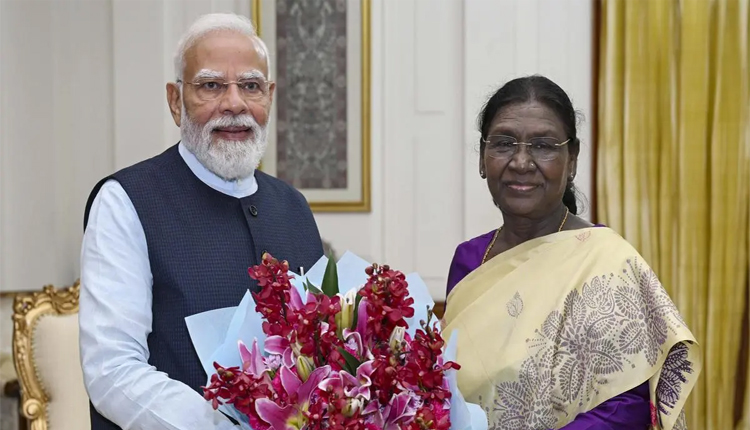
New Delhi: The grandiose halls of Rashtrapati Bhavan had just emptied after the heavy protocol of the Civil Investiture Ceremony for the Padma Awards on Tuesday. Yet, as the dignitaries dispersed, the quiet of the presidential palace gave way to an electric political buzz. Prime Minister Narendra Modi walked down the corridors to meet President Droupadi Murmu, a seemingly routine courtesy call that has instantly sent Lutyens’ Delhi into overdrive.

In Indian politics, a sudden meeting between the Prime Minister and the Head of State is rarely just a social visit. This interaction comes precisely at a time when speculations about an impending Union Cabinet reshuffle are reaching a crescendo. With parliamentary terms expiring and key ministers shifting into party organization roles, the bureaucratic gears in the national capital are visibly turning.
Adding immediate fuel to the fire was a significant departure from the Council of Ministers earlier that very day. George Kurian, a veteran BJP leader from Kerala, tendered his resignation from the Union Cabinet. The 65-year-old leader, who served as the Minister of State for Minority Affairs alongside Fisheries, Animal Husbandry, and Dairying, stepped down after his Rajya Sabha term expired on June 21. Rashtrapati Bhavan confirmed that President Murmu has accepted his resignation. The party’s decision not to renominate Kurian during the recent Rajya Sabha polls was the first clear indicator that changes were afoot.
Kurian is not an isolated case. Minister of State for Railways, Ravneet सिंह (Singh), whose Rajya Sabha tenure from Rajasthan also concluded on June 21, found himself without a fresh nomination from the BJP. Singh, who additionally holds the portfolio of Minister of State for Food Processing Industries, now commands intense interest from political observers mapping out the new look of the central government.
The structural changes are driven by a strategic realignment within the ruling Bharatiya Janata Party. The leadership has been systematically moving central ministers back to their home turf to steer the party organization. Just last month, on May 28, BJP National Executive member Nitin Nabin announced the appointment of Harsh Malhotra as the new Delhi BJP Chief. The 62-year-old Malhotra currently shoulders double ministerial duties as the MoS for Road Transport and Highways, and Corporate Affairs. Similarly, Minister of State for Finance Pankaj Chaudhary was handed the reins of the party’s critical Uttar Pradesh unit late last year.
Historically, when ministers are reassigned to heavy-duty organizational positions, it creates a systemic vacuum at the Center. This structural shift, combined with the vacant slots left by outgoing Rajya Sabha members, makes a Cabinet churning inevitable. While the official stance remains focused on routine administrative dialogues, the timing of the Prime Minister’s visit strongly hints that the blueprint for a leaner, repurposed Council of Ministers is now on the President’s desk.
Comments are closed.