

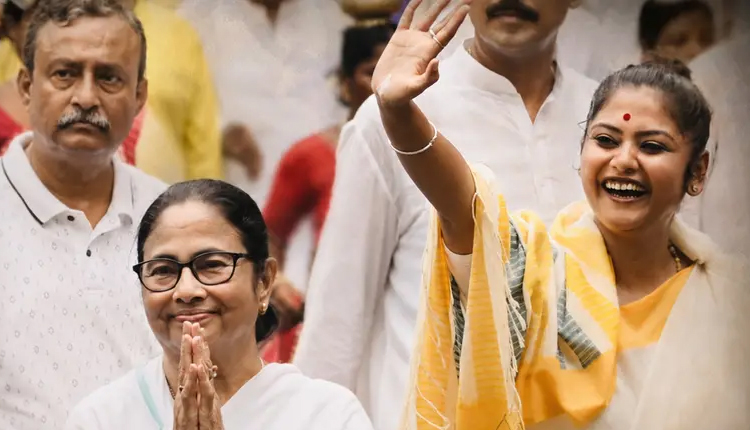
New Delhi: The Trinamool Congress in West Bengal has been hit by a massive organizational shakeup amid an unprecedented internal crisis. In a major move on Sunday, party supremo Mamata Banerjee removed Jadavpur Lok Sabha Member of Parliament Sayoni Ghosh from her position as the state youth president. The drastic organizational restructuring comes as the ruling party battles a severe internal rebellion and rumors of a massive split among its top tier parliamentarians.

The ruling party has been thrown into complete disarray following recent electoral setbacks, with internal friction within the grassroots structure boiling over. Only a few days ago, reports surfaced that up to nineteen breakaway Lok Sabha members had signed a joint dissent note. Among the senior leaders, veteran lawmaker Sudip Banerjee, a decades old companion of Mamata Banerjee, reportedly abandoned her camp and traveled to New Delhi to hold crucial high level meetings with Union Home Minister Amit Shah and Union Minister Bhupender Yadav.
In swift response to this widening rift, the party leadership executed a sweeping structural purge to reclaim authority. Arnab Bandyopadhyay has been appointed as the new Trinamool Youth Congress president, officially replacing Sayoni Ghosh. Furthermore, Sudip Banerjee was stripped of his organizational responsibilities as the North Kolkata Trinamool President, with that post being promptly handed over to Kunal Ghosh. In another major change, Mala Roy was replaced by Alipha Ahmed as the chief of the party state women wing. Sources indicate that the rebel bloc of lawmakers plans to meet the Lok Sabha Speaker on Monday to officially demand a separate legislative block that intends to extend support to the National Democratic Alliance.
This unprecedented churning within the ruling party has triggered widespread political uncertainty across West Bengal. For the general public and ground level party workers, the visible fracturing of the party top brass raises critical questions about regional political stability. Observers note that the sudden removal of high profile faces like Ghosh, who is widely considered a popular public leader, highlights the extreme measures the party core leadership is taking to prevent further defections.
As the state gears up for upcoming legislative developments, the major overhaul within the Trinamool hierarchy serves as a definitive turning point. While the high level replacements aim to plug organizational leaks, the ongoing rebellion presents the most severe structural test yet for Mamata Banerjee. The upcoming days will reveal whether these aggressive corrective measures can successfully stem the tide of internal dissent or if the state is heading toward complete political realignments.
Comments are closed.