

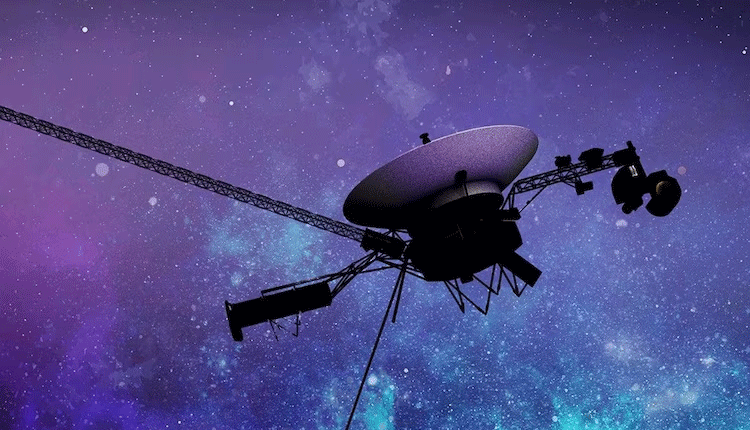
Washington: NASA’s Voyager 1 spacecraft has achieved a historic milestone, becoming the first human-made object to reach a distance of one “light-day” from Earth. On November 18, 2026—exactly 49 years, two months, and 11 days after its launch—the veteran probe crossed nearly 26 billion kilometres into deep space.

Travelling at roughly 3 lakh kilometres per second, light covers about 25.9 billion kilometres in 24 hours, defining one light-day. While sunlight takes just eight minutes to reach Earth and signals to Neptune take around four hours and 10 minutes, any radio command sent to Voyager 1 now takes a full 24 hours to arrive. Receiving a response takes another day, making every exchange a 48-hour round trip.
Launched from Cape Canaveral on September 5, 1977, the 800-kilogram spacecraft, fitted with a 3.7-metre dish antenna, capitalised on a rare alignment of Jupiter, Saturn, Uranus, and Neptune that occurs once in roughly 175 years. Using planetary gravity assists, Voyager 1 flew past Jupiter in 1979 and Saturn in 1980, transmitting detailed images and data before heading beyond the solar system.
In 2012, the probe crossed the heliosphere—the vast protective bubble shaped by the Sun’s magnetic field and solar winds—to become the first human-made object to enter interstellar space. Moving at nearly 61,000 kilometres per hour, it covers about 3.5 astronomical units annually, with one astronomical unit roughly equal to 15 crore kilometres.
Celebrating the landmark on X, Dr Narottam Sahoo described the mission as “a magnificent triumph of human ingenuity, scientific curiosity and perseverance.” He added, “Voyager 1 reminds us that the spirit of exploration knows no boundaries, and that the quest for knowledge can take humanity beyond the farthest horizons of imagination.”
Remarkably, Voyager 1 continues to communicate using a transmitter powered by just 22 watts—comparable to a small household bulb—beaming data to NASA’s Deep Space Network at around 160 bits per second. Because sunlight is far too faint for solar panels at that distance, the spacecraft relies on nuclear power, which diminishes every year. To extend its life, NASA engineers have gradually switched off heaters and scientific instruments. While Voyager 1 is expected to remain operational until the early 2030s, it will continue drifting silently through interstellar space long after its final signal fades.