

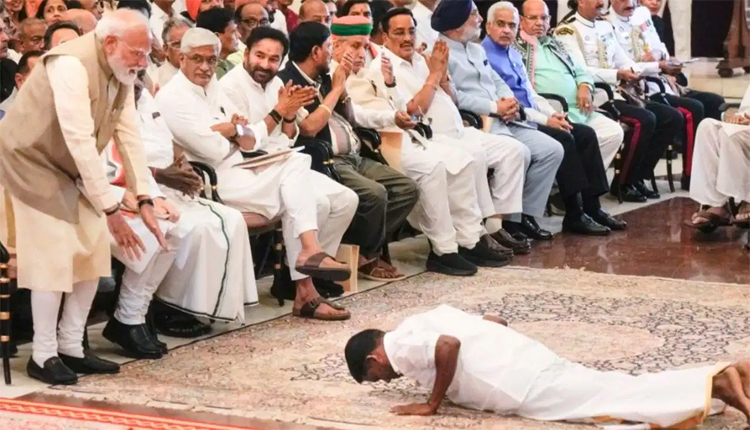
New Delhi: Puducherry’s renowned Silambam guru K Pajanivel became one of the most talked about faces at the Padma awards ceremony after he bowed down before Prime Minister Narendra Modi in a traditional gesture of respect at Rashtrapati Bhavan. The moment drew attention as PM Modi immediately stepped forward, held his hand and helped him rise.

President Droupadi Murmu conferred Padma awards on 66 personalities at Monday’s ceremony. The government had approved 131 Padma awards for 2026, including five Padma Vibhushan, 13 Padma Bhushan and 113 Padma Shri awards. At the event, two Padma Vibhushan, six Padma Bhushan and 58 Padma Shri awards were presented.
K Pajanivel, who hails from Puducherry, was honoured with the Padma Shri for his contribution to Silambam, a traditional martial art with deep roots in Tamil culture. As his name was called for the award, he first offered a full prostration before the Prime Minister. Modi, noticing the gesture, quickly moved towards him and helped him stand. Pajanivel later proceeded towards the President, touched her feet and received the honour.
Born on January 30, 1973, in Pooranankuppam, Puducherry, Pajanivel began learning Silambam under the guidance of Master Rajaram. Over the years, he has played an important role in preserving, promoting and popularising the ancient Tamil martial art in India and abroad. He has also trained several students free of cost to ensure that the tradition continues among younger generations.
Before the Padma Shri, Pajanivel had received several honours. He was conferred the Sangeet Natak Akademi Award in 2023, the Kalaimamani Award by the Puducherry government in 2012, the Best Youth Award by Nehru Yuva Kendra in 2004 and the Silambam International Award in 2002.
After receiving the Padma Shri, Pajanivel said he saw the recognition as encouragement for his work of taking Tamil heritage to the world for more than four decades. He also said Silambam should be taught in schools.
Silambam is a traditional martial art of Tamil Nadu, believed to be thousands of years old. It uses a flexible bamboo staff as the main weapon and is known for speed, footwork, body control and agility. The art form has references in ancient Tamil Sangam literature and was historically used for self defence and warfare.
Comments are closed.