

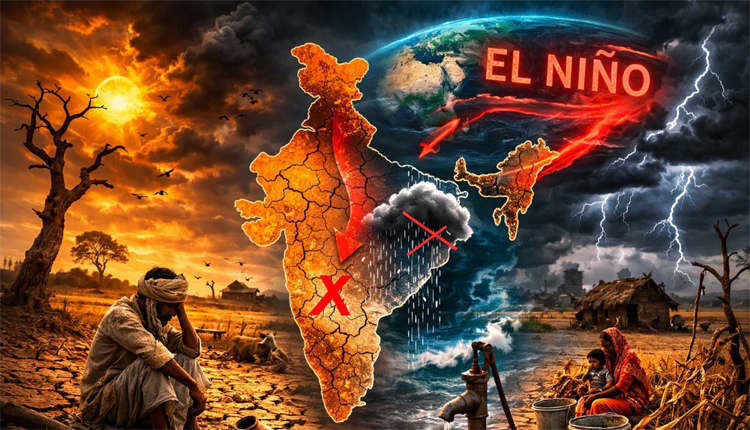
New Delhi: India may be staring at another difficult climate test as scientists track the possibility of a strong El Niño developing over the Pacific Ocean, a weather pattern that can disturb rainfall, intensify heat and place fresh pressure on agriculture and water resources.
El Niño refers to the abnormal warming of surface waters in the central and eastern Pacific Ocean. This warming may look distant on the map, but its impact can travel across continents by changing wind patterns, rainfall distribution and global temperatures. When the warming becomes unusually strong, it is often described as a Super El Niño.
The concern has grown because global agencies are now watching a possible El Niño event in 2026. The US Climate Prediction Center has said there is an 82 percent chance of El Niño developing between May and July 2026, and a 96 percent chance that it will continue into the Northern Hemisphere winter from December 2026 to February 2027.
For India, the timing is crucial. The southwest monsoon is the backbone of the country’s rural economy, feeding crops, reservoirs and drinking water systems. Any major disruption in monsoon rainfall can affect farmers, food prices and power demand. The India Meteorological Department’s climate model has also indicated the possible development of El Niño conditions during the southwest monsoon season.
According to climate experts, El Niño years in India are often linked with hotter summers and below normal rainfall, though the impact is not always uniform. Some regions may face long dry spells, while others may see sudden heavy rain. This uneven pattern makes planning difficult for farmers who depend on timely sowing and stable rainfall.
The worry is not only about daytime heat. Warmer nights are equally dangerous because they do not allow the human body to recover from the stress of extreme temperature. For daily wage workers, elderly people, children and people living in poorly ventilated houses, this can become a serious health risk.
The agriculture sector may feel the sharpest impact. A weak or erratic monsoon can reduce soil moisture, delay sowing and affect crops such as paddy, pulses, oilseeds and vegetables. If production suffers, the pressure can eventually move from fields to markets, raising concerns over food inflation.
Water security is another major issue. Below normal rainfall can affect reservoirs, groundwater recharge and irrigation supply. In cities, it can push up demand for electricity as heat increases the use of fans, coolers and air conditioners. In rural areas, farmers may need to depend more on diesel pumps, adding to cultivation costs.
The World Meteorological Organization has also warned that El Niño is expected to develop from mid 2026 and may influence global temperature and rainfall patterns. India has reason to watch this closely because even a small change in monsoon behaviour can affect millions of livelihoods.
However, experts also caution that El Niño does not automatically mean a failed monsoon. The final rainfall pattern depends on several other factors, including the Indian Ocean Dipole, local weather systems, soil moisture and the progress of monsoon winds.
The message for India is clear. A possible Super El Niño is not just a weather story. It is a warning for public health planning, crop management, water conservation and disaster preparedness. As the climate becomes more unpredictable, early action may decide how well India handles the heat and rainfall stress ahead.
Comments are closed.