

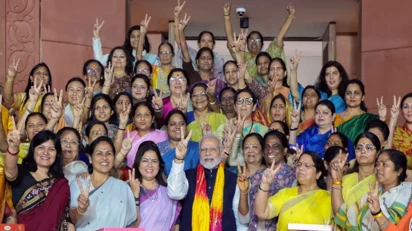
New Delhi: In a landmark procedural move, the Union Government has officially notified the commencement of the Women’s Reservation Act, 2023 (the 106th Constitutional Amendment), effective from April 16, 2026.

The notification, issued by the Ministry of Law and Justice, serves as the formal “starting gun” for a radical restructuring of the Indian legislature, aimed at ensuring 33 per cent representation for women by the 2029 general election.
While the Act received presidential assent in September 2023, its implementation remained legally dormant until this week. The timing of the notification is seen as a strategic prerequisite for the Constitution (131st Amendment) Bill, 2026, which was debated in a special three-day sitting of Parliament ended on Friday.
The 816-Seat Vision
The notification marks the transition from legislative intent to administrative action. Under the proposed 2026 amendments, the government intends to bypass the requirement for a post-2026 census by using 2011 Census data as the baseline for an immediate delimitation exercise.
This plan envisions a vastly expanded Lok Sabha, growing from its current 543 members to a staggering 816 seats. Within this new framework, approximately 273 seats would be exclusively reserved for women. Home Minister Amit Shah assured the House that this “surgical expansion” would ensure no state — particularly those in the South — loses absolute seat count, though their proportional influence remains a point of fierce debate.
‘Nari Shakti’ Vs ‘Political Weaponry’
Prime Minister Narendra Modi, in an open letter to the nation’s women, hailed the move as “non-negotiable” for India’s development. He urged all political parties to support the fast-tracking of the quota, framing it as a debt of justice to “half of India’s population.”
However, the Opposition has responded with a mixture of support for the quota and suspicion regarding the “packaging.” Congress leaders, including Priyanka Gandhi Vadra, have described the bundling of women’s reservation with a major delimitation exercise as a “Trojan horse”. They argue that redrawing boundaries based on old data could be weaponised to “slice and dice” constituencies to the advantage of the ruling party.
A Three-Year Sprint
With the 2023 Act now officially “in force”, the clock has begun ticking for the Delimitation Commission. Should the 131st Amendment pass this week, the commission will have less than three years to redraw the electoral map of the world’s largest democracy.
For the millions of women aspiring to enter the halls of power, the notification provides a glimmer of certainty. Yet, for the federal structure of India, it marks the beginning of an era of unprecedented territorial and political flux.
Comments are closed.