

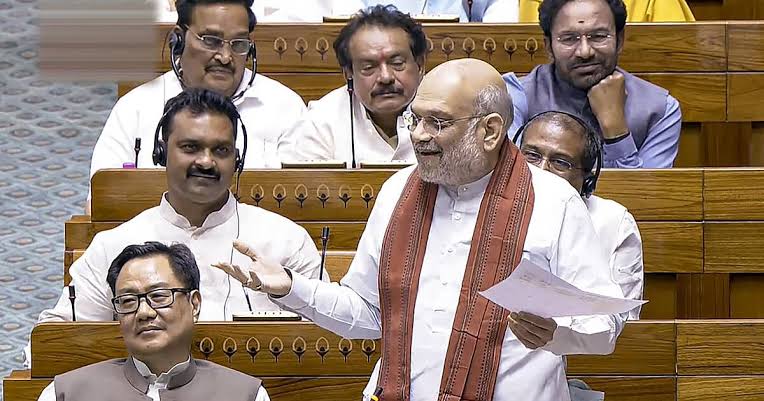
New Delhi: In a spirited defence of the government’s legislative agenda, Union Home Minister Amit Shah has categorically dismissed fears of a regional imbalance in the forthcoming delimitation exercise.

Addressing the Lok Sabha during a high-stakes debate on April 16, Shah assured the House that the redrawing of electoral boundaries would not diminish the political influence of southern states but rather enhance their representation in a vastly expanded Parliament.
Intervening in the discussion on a trio of landmark bills, the Constitution (131st Amendment) Bill, the Delimitation Bill 2026, and the Union Territories Laws (Amendment) Bill, Shah provided a data-driven rebuttal to Opposition claims of “gerrymandering” and regional bias.
2029: The Status Quo Deadline
Shah provided a crucial operational timeline, clarifying that the current electoral map remains set in stone for the immediate future. “I wish to state unequivocally that every election conducted until 2029 will be held under the existing system, with the current number of seats and established practices,” he informed the House.
The Home Minister emphasised that the Delimitation Commission’s report would only take effect after receiving the formal nod from both Parliament and the President of India, a process that will not conclude before the next general election cycle.
The ‘Southern Surge’
Addressing the “false narrative” that southern India would lose its voice to the Hindi heartland, the Home Minister presented a blueprint for an 816-seat Lok Sabha, a 50 per cent increase from the current 543. Under this model, he argued, the collective strength of the southern states would rise from 129 to 195 seats.
Tamil Nadu: Expected to see its representation grow from 39 to 59 seats.
Karnataka: Set for an increase from 28 to 42 seats.
Telangana: Projected to rise from 17 to 26 seats.
Kerala: Anticipated to reach a total of 30 seats.
“The percentage share of southern states in the House will remain virtually unchanged at approximately 24 per cent,” Shah noted, reassuring members that the federal balance of power is being preserved “to the very comma and full stop” of the existing Delimitation Act.
Caste Census And Democratic Resilience
The Home Minister also tackled the Opposition’s demand for a caste census, confirming that the Modi administration remains committed to the exercise. He explained that the ongoing census is a two-phase operation: the first focuses on house-listing and the second on individual enumeration.
He dismissed the lack of a “caste” column in the current phase as a procedural necessity rather than a policy omission. In a direct riposte to Congress leader Priyanka Gandhi’s earlier “attack on democracy” remarks, Shah asserted that the strength of India’s democracy lies in the mandate of its 1.3 billion citizens, which no political entity could manipulate. “History proves that whenever attempts have been made to undermine our democratic fabric, the people have delivered a resounding rejection,” he stated.
The Home Minister’s speech has served to frame the 2026 amendments not as an electoral tactic but as a long-overdue restructuring of the world’s largest democracy.
Comments are closed.