

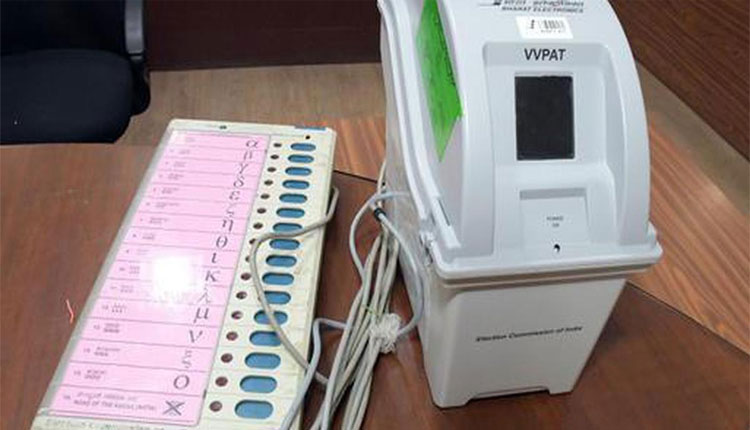
New Delhi: In a move to bolster public confidence and satisfy judicial mandates, the Election Commission of India (ECI) has institutionalised a rigorous “diagnostic check” for the microcontrollers of Electronic Voting Machines (EVMs).

This technical post-mortem, colloquially known as checking the ‘burnt memory’, has become a pivotal safeguard in the nation’s democratic process, ensuring that the silicon heart of every ballot remains untainted.
The procedure, refined following landmark directions from the Supreme Court in April 2024 and further clarified in 2025, allows candidates who finish second or third to request a formal verification of up to 5 per cent of the machines in their constituency. But what exactly does this high-stakes audit entail?
The Silicon Signature: Burnt Memory Explained
At the core of every EVM, comprising the Control Unit, the Ballot Unit, and the VVPAT, is a “One-Time Programmable” (OTP) microcontroller. During manufacturing at Bharat Electronics Limited (BEL) or the Electronics Corporation of India Limited (ECIL), the electoral software is permanently “burnt” into this chip.
Because the memory is OTP, the code cannot be altered, overwritten, or erased without physically destroying the chip. The diagnostic check is essentially a forensic verification that the “firmware signature” on the chip matches the original, authorised version installed at the factory.
The Diagnostic Protocol
The verification process is a meticulous, multi-step operation conducted by a specialised team of engineers from the original manufacturers, performed in the presence of the contesting candidates.
Authentication & Integrity
Engineers use external tools to read the metadata of the microcontroller. This confirms that the “unauthorised access detection mechanism” (UADM) has not been triggered.
Mutual Authentication
When the units are powered on and interconnected, they perform a digital “handshake”. If any unit — or its memory — has been tampered with, the units will fail to authenticate, rendering the machine inoperable.
Data Retention
Crucially, the Supreme Court has mandated that during this diagnostic phase, the actual poll data must not be erased or reloaded. The engineers simply certify that the “burnt” programme remains original and intact.
Symbol Loading Unit (SLU) Audit
The check now extends to the SLU, the device used to load candidate symbols into the VVPAT.
This ensures that no “Trojan Horse” or malicious software was introduced during the symbol-loading phase.
A Tiered Transparency
To make the process accessible yet sustainable, a tiered fee structure has been introduced. Candidates can opt for a preliminary “self-diagnostic test” to verify machine health. If doubts persist, they may proceed to a full-scale mock poll, where the machine is put through its paces to demonstrate that every button press corresponds accurately to the recorded electronic result and the printed VVPAT slip.
For the first time in Indian electoral history, as seen in recent scrutiny in Maharashtra’s Chandivli constituency, the judiciary has opened the “black box” of election technology to public oversight. While the ECI maintains that the machines are “agnostic” to political parties, this forensic audit serves as a vital pressure valve for the friction between technology and trust.
Comments are closed.