

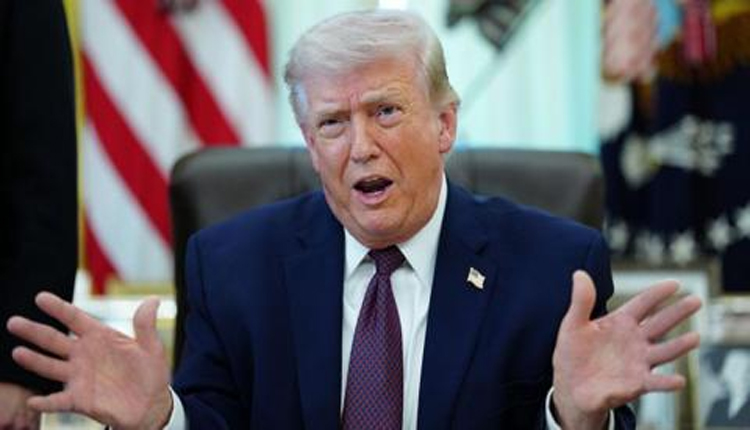
Washington: In a dramatic recalibration of the conflict in the Middle East, President Donald Trump has signalled a strategic shift from direct military confrontation towards a campaign of “economic submission” against Tehran.

The move comes in the wake of a 21-hour marathon of peace negotiations in Islamabad that ended in a bitter stalemate, leaving the global energy market in a state of high alert.
The collapse of the talks, which Vice-President J D Vance spearheaded alongside Iranian parliamentary speaker Mohammad Bagher Ghalibaf, has pushed the Trump administration to rethink its “Operation Epic Fury” playbook. While the White House maintains that military objectives, including the decimation of the Iranian navy and missile infrastructure, are “nearing completion”, whispers from the Pentagon suggest a growing pragmatism dictated by a looming shortage in advanced precision-guided munitions.
The Munitions Conundrum
As the conflict enters its second month, defence analysts have highlighted the strain on US stockpiles. With thousands of sites struck across Iran and over 13,000 combat flights logged, the “unrelenting” pace of the air campaign has raised questions regarding the long-term sustainability of the current military posture. Privately, administration officials have been urged to consider the “Vietnam-style” guerrilla warfare strategy that Iran has reportedly prepared.
Faced with the prospect of a costly and protracted ground operation, President Trump appears to be opting for a naval blockade of the Strait of Hormuz, a move intended to choke the Iranian economy into compliance without the further expenditure of dwindling high-tech ordnance.
The Islamabad Standoff
The Islamabad negotiations reportedly foundered on the intractable issue of nuclear capability. While Washington demanded an absolute commitment that Tehran would never seek the tools for a nuclear weapon, the Iranian delegation insisted that the US had failed to win their trust.
In a characteristic show of force following the breakdown, Trump threatened to target Iran’s “most basic essentials”, including water desalinisation plants, bridges, and the power grid. “The only thing left, really, is their water,” the president told Fox News, “I would hate to do it, but it’s very easy to hit.”
A Global Economic Fallout
The shift to a naval blockade has already sent Brent crude futures soaring past the $102 mark, as nearly 20 per cent of the world’s oil supply remains trapped behind a geopolitical choke point.
The Treasury Department has moved to leverage secondary sanctions against China, the UAE, and Oman, accusing them of allowing illicit Iranian financial flows. As the US prepares for a “pivot to economic warfare”, the gamble for the Trump administration is whether a financial siege will prove more effective than a rain of fire. For the global community, the concern remains whether this “peace through strength” strategy will lead to a diplomatic breakthrough or a catastrophic escalation that redraws the map of the Middle East.
Comments are closed.