

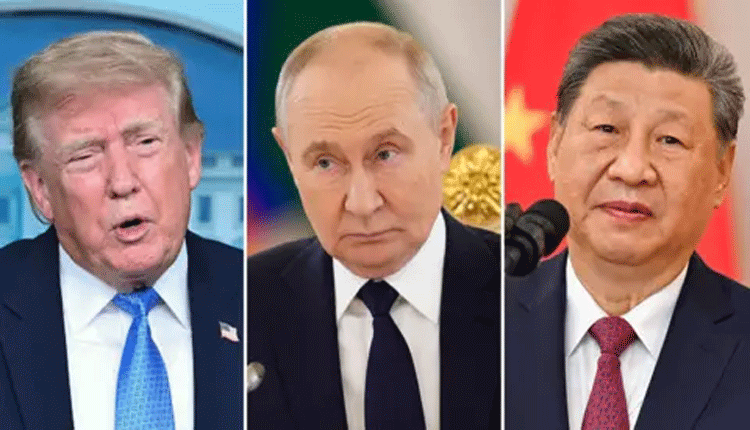
Shenzhen: Eighty-one years after the consequential Yalta Conference shaped the post-World War II global order, the world’s three preeminent powers are preparing for an unprecedented trilateral summit. US President Donald Trump, Russian President Vladimir Putin, and Chinese President Xi Jinping are scheduled to hold talks on November 19 on the sidelines of the Asia-Pacific Economic Cooperation (APEC) forum in Shenzhen, China.

The proposed meeting has triggered anxieties across global capitals, drawing swift comparisons to the 1945 Yalta summit where Franklin D. Roosevelt, Winston Churchill, and Joseph Stalin partitioned territories and established a new world order.
Diplomatic observers and smaller nations fear that the three modern nuclear powers might negotiate a “grand bargain” that impacts regions like Ukraine and Taiwan without their direct participation. Each leader arrives in Shenzhen with distinct strategic priorities. For Putin, the summit presents a critical window to secure a resolution to the Ukraine war on terms favourable to Moscow. Meanwhile, the Trump administration is heavily focused on nuclear arms control.
Following the expiration of the New START treaty between the US and Russia in February 2026, Washington wants a new framework that actively includes Beijing. However, China remains hesitant. According to January 2026 data from the Stockholm International Peace Research Institute (SIPRI), Russia and the US hold 5,420 and 5,042 nuclear warheads respectively, while China trails significantly with 620. Beijing has consistently argued that its comparatively smaller arsenal makes entering such a tripartite nuclear pact premature.
The White House has made its agenda clear. Spokesperson Olivia Wales told reporters that President Trump will firmly insist on a discussion regarding nuclear non-proliferation. On the Russian side, Kremlin spokesperson Dmitry Peskov confirmed that the parties are exchanging suggestions for the agenda, though he dismissed the “Yalta 2.0” comparisons, stating that decisions made by the three leaders cannot be unilaterally imposed on other sovereign nations. Despite these reassurances, regional allies remain on high alert.
Wen-Ti Sung, a political scientist at the Australian National University, highlighted Taipei’s concerns to news agency AFP, noting, “If the Trump administration is open to abandoning one partner (Ukraine) out of convenience, then it can abandon another.”
Beyond Ukraine and nuclear proliferation, the leaders are also expected to deliberate on the ongoing conflict involving Iran and Israel, a matter of deep concern for China given its reliance on Middle Eastern energy supplies.