

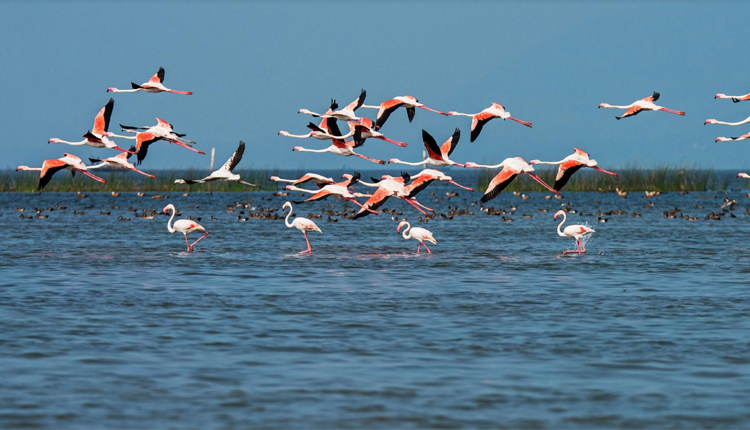
New Delhi: As winter blankets the northern hemisphere, millions of migrant birds embark on epic journeys spanning thousands of kilometres, guided by nature’s own navigation tools — the sun, stars, and Earth’s magnetic field — to reach India, their warm winter haven.
These avian travellers, including ducks, flamingos, bar-headed geese, and rare Siberian cranes, use a remarkable toolkit for orientation. During the day, they rely on the sun’s position, aided by a special protein in their eyes that detects ultraviolet light even through clouds. At night, their brains store star maps, allowing them to navigate by constellations. Magnetite crystals in their beaks and brains act as a natural compass, sensing Earth’s magnetic field, while jet streams help them glide efficiently at high altitudes.
Why India? While Siberian winters plunge to -50°C with frozen lakes and scarce food, India’s mild climate and abundant wetlands, rivers, and rice fields offer ideal refuges. The Himalayas shield the subcontinent from harsh northern winds, creating a safe zone. Historical ties run deep — some species have migrated here for over 10,000 years, routes encoded in their DNA.
Birds arrive in phases: Amur falcons and rosy starlings in September, ducks and flamingos in October (with 50-60 lakh ducks and 5-6 lakh flamingos annually), and hardy bar-headed geese and Siberian cranes (now only 50-70) in November. The latter fly at 8–9 km altitude over Everest, showcasing extraordinary adaptations, like specialised blood for low oxygen.
These journeys, covering 10,000–15,000 km from Siberia, Mongolia, and Central Asia, take weeks with strategic stops. India’s vast wetlands remain a critical sanctuary amid shrinking habitats elsewhere.
Comments are closed.