

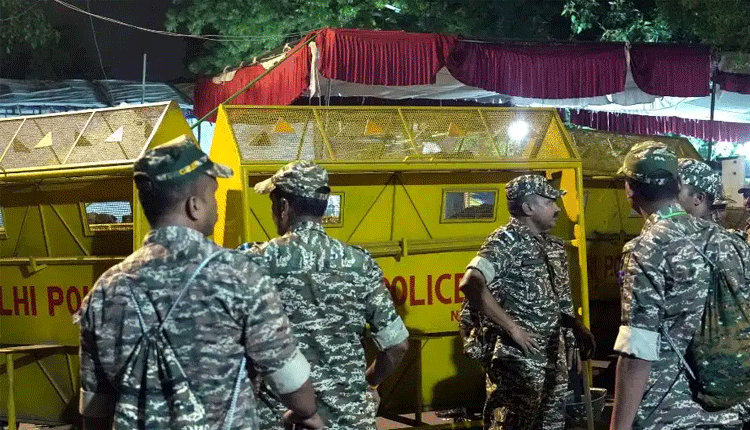
New Delhi: While the government has agreed to withdraw the FIRs lodged against students during the 36-day Jantar Mantar agitation, legal experts clarify that a mere political announcement does not automatically cancel the charges. The withdrawal must undergo a strict legal procedure under the newly implemented Bharatiya Nagarik Suraksha Sanhita (BNSS), 2023.

Between June 13 and July 25, 2026, protesting students faced around 15 to 20 FIRs in Delhi alone, with additional cases registered in other states following their Parliament march on July 20. Although the government has shown a green signal to scrap these cases, the law dictates that once an FIR is officially registered, it can only be quashed at the doorstep of the judiciary.
The primary route for case withdrawal now falls under Section 360 of the BNSS, which replaced Section 321 of the CrPC on July 1, 2024. The process begins with the state or central cabinet taking a “policy decision” to withdraw the cases in public interest based on the Home Department’s recommendation. Following this, the public prosecutor submits a formal application to the relevant magistrate or court.
A crucial change under the new BNSS rules mandates that the court must hear the victim’s side before dismissing a case. In situations involving damage to public property, the concerned government department acts as the victim and may be directed to record its statement. Ultimately, the judge holds the final authority. If the court is convinced that the withdrawal serves justice and public interest, the FIRs are permanently quashed.
Alternative legal avenues are also available if hurdles arise. Police can file a final closure report if they find insufficient evidence before submitting a charge sheet. For more severe charges, either the students or the government can approach the High Court under BNSS Section 528 (formerly CrPC 482) to quash politically motivated cases. Minor infractions like blocking roads or violating Section 144 can be resolved swiftly through mutual consent in Lok Adalats.
This legal journey mirrors the aftermath of the 2020-2021 farmers’ protest. Despite similar promises of case withdrawals, data presented in the Rajya Sabha in December 2022 showed that the Home Ministry withdrew 86 cases in Delhi and Chandigarh, the Railway Ministry withdrew 34 cases, and Haryana approved the withdrawal of 163 cases. However, the Samyukt Kisan Morcha (SKM) has maintained that thousands of the roughly 1.48 lakh FIRs registered nationwide remain active, forcing farmers to continue making court rounds years later.
Comments are closed.