

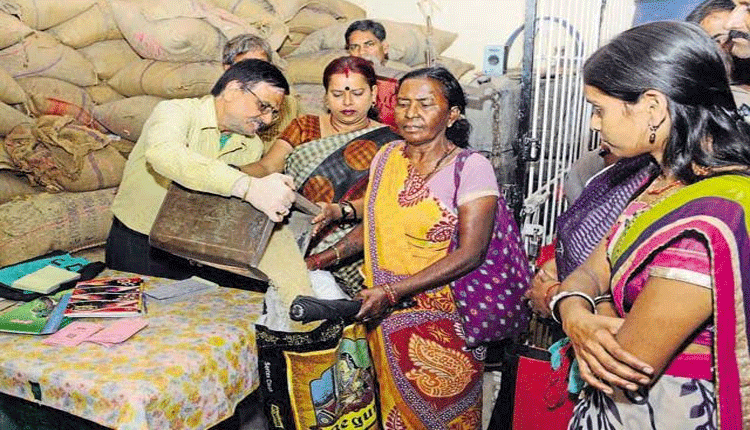
New Delhi: In an era of rapid digital transformation, India’s massive public distribution system (PDS) is still anchored to a demographic reality from over a decade ago. The eligibility for free rations under the National Food Security Act (NFSA) of 2013 continues to be determined by the 2011 Census, leaving millions of vulnerable families—especially those who expanded after 2011—outside the crucial safety net.

The NFSA mandates that highly subsidized or free food grains be provided to up to 75 percent of the rural population and 50 percent of the urban population. Currently, this translates to roughly 81.35 crore beneficiaries nationwide, a figure based entirely on population statistics calculated in 2011. Since December 2022, the central government has waived even the nominal fees (Rs 3 for rice, Rs 2 for wheat, and Re 1 for coarse grains), making the grains entirely free for eligible households under priority and Antyodaya Anna Yojana (AAY) schemes.
However, economists and food rights activists point out a glaring systemic flaw: population growth and demographic shifts since 2011 remain unaccounted for. A child born in 2015, or a family that fell into poverty during the economic upheavals of recent years, is virtually invisible to the current rationing formula. Consequently, two equally impoverished neighbours might face vastly different realities simply because one made the 2011 list and the other did not.
While the government spends over Rs 2 lakh crore annually on food security to combat malnutrition, the outdated quota system forces many unlisted, needy households to rely on open market purchases or local borrowing to survive.
Despite these exclusionary flaws, the system has seen significant technological advancements. The widespread implementation of electronic point-of-sale (ePoS) machines and the ‘One Nation One Ration Card’ scheme have successfully curtailed leakages and allowed migrant workers to access their food quotas anywhere in the country. Yet, these technological leaps cannot bypass the foundational problem: the quota limit itself.
Until a new national census is conducted and the baseline figures are updated, the structural discrepancy will persist, leaving millions of genuinely poor families waiting for their rightful inclusion in one of the world’s largest food security programs.