

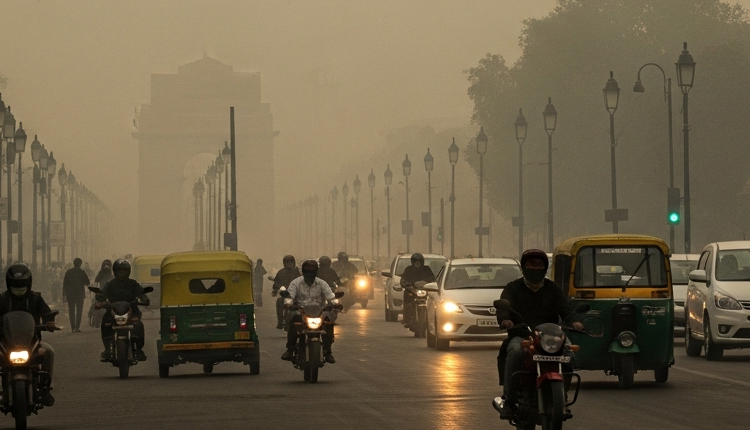
New Delhi: In a major relief for the residents of the national capital, the Air Quality Index (AQI) in Delhi and the surrounding National Capital Region (NCR) has shown significant improvement. The AQI, which had alarmingly breached the 400-mark (severe category) earlier this November, dropped to 204 (poor category) on Tuesday.

Following this notable downward trend in pollution levels, the Commission for Air Quality Management (CAQM) decided to revoke the Graded Response Action Plan (GRAP) Stage 3 restrictions with immediate effect. However, measures under GRAP Stage 1 and Stage 2 will remain in force to prevent the air quality from deteriorating again.
Environmental experts and meteorological agencies have identified seven primary reasons behind this sudden and rapid improvement in Delhi’s air quality.
The most crucial factor was the increase in wind speed. For several days, calm and stagnant winds had trapped pollutants near the surface. As wind speeds picked up, the accumulated PM2.5 and PM10 particles were efficiently dispersed. Secondly, the light drizzle and scattered showers experienced across Delhi-NCR on November 15 played a vital role in settling the suspended dust and particulate matter, effectively washing the lower atmosphere.
The third reason is a favourable shift in meteorological conditions, including changing wind directions that prevented external pollutants from entering the city. Fourth, the strict enforcement of GRAP-3 rules—which included a blanket ban on non-essential construction and demolition activities, as well as restrictions on certain polluting vehicles—significantly curbed local emissions.
The fifth contributing factor was the gradual clearing of the heavy smog that had built up immediately following Diwali due to firecrackers. Sixth, local authorities aggressively implemented dust control measures, including widespread water sprinkling on arterial roads to suppress dust generated by vehicular movement. Finally, the emergence of bright sunshine helped increase the mixing height in the atmosphere, allowing pollutants to rise and disperse rather than remaining trapped near the ground.
While the lifting of GRAP-3 eases restrictions on construction activities, the CAQM has strictly advised that all anti-pollution actions under GRAP Stages 1 and 2, mandated on October 30, will continue. Authorities remain on high alert, as the characteristic drop in temperatures and low wind speeds expected in December could easily push the AQI back into the severe zone if local emissions are not kept in check.