

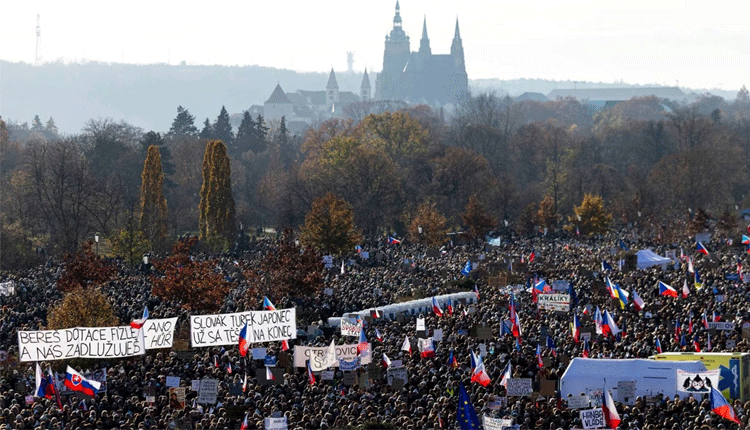
Prague: Hundreds of thousands of demonstrators flooded Prague’s Letná Plain on Sunday in what is being widely described as the Czech Republic’s largest anti-government protest since the historic 1989 Velvet Revolution. The massive rally, driven by mounting fears over press freedom, targeted Prime Minister Andrej Babiš’s coalition government and its controversial plan to overhaul the funding structure of public media.

The contentious legislation aims to abolish the current system where Czech Television and Czech Radio are sustained by regular broadcasting fees paid directly by households and businesses.
Instead, the Babiš administration proposes financing these public broadcasters straight from the state budget. Critics, journalists, and media watchdogs argue this structural shift could lead to a 15 percent budget reduction and fatally compromise editorial independence by making the media financially reliant on the ruling party’s goodwill.
The demonstration was organised by the civic group Million Moments for Democracy (Milion chvilek pro demokracii). Addressing the sea of protesters, the group’s chairman, Mikulas Minar, asserted, “An elected government has the right to govern but it does not have the right to do whatever it wants and to dismantle democratic institutions.”
Throughout the rally, protestors drew sharp parallels to the erosion of independent journalism witnessed in neighbouring European nations like Hungary and Slovakia.
The government’s legislative push secured its first preliminary approval in the lower house of parliament during a swift early-morning session last month, a move that immediately triggered a one-day warning strike by broadcast staff.
Defending the reform, Prime Minister Babiš dismissed all allegations of a state-sponsored media takeover. He argued that scrapping the compulsory licence fee would provide crucial financial relief to lower-income families and encourage greater operational efficiency within media houses, insisting last week that “nobody wants to control public media” and that the protesters’ fears are unfounded.
Despite these official reassurances, the sheer scale of the weekend protests—with organisers estimating an attendance of up to 400,000 people—highlights a deepening democratic rift in the Central European nation.
As the media bill awaits further parliamentary debate, the ongoing standoff sets the stage for a crucial battle over the independence of civic institutions in the region.