

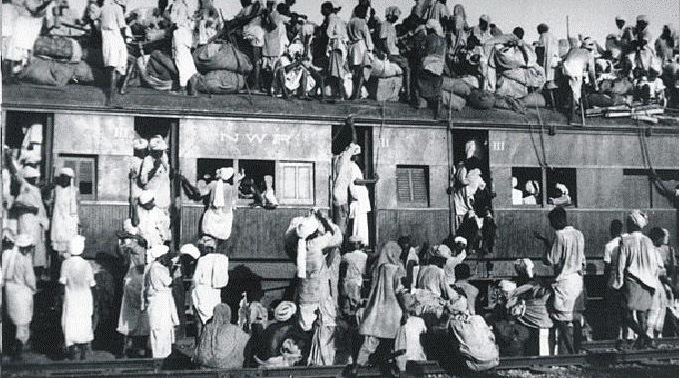
New Delhi: The brutal partition of India and Pakistan in 1947 was not the sudden result of a single meeting, a hasty agreement, or a fleeting whim. Instead, the foundation of this massive human tragedy was laid through decades of complex historical events, policy shifts, and political decisions starting from the historic revolt of 1857 up to the Khilafat Movement in 1920.

For decades, political narratives and simplistic conclusions have heavily dominated the discourse surrounding the partition. A popular narrative often circulated through brief social media forwards suggests a straight line from the British arrival to their divide and rule policy, followed by appeasement and the ultimate creation of Pakistan. However, historical evidence reveals a much more intricate and nuanced reality. It raises compelling questions about how Mohammad Ali Jinnah, who was widely hailed as the greatest ambassador of Hindu Muslim unity in 1916, eventually became the central architect of the partition.
The aftermath of the 1857 rebellion marked a significant turning point in Indian history. After the revolt, the British administration realized they could no longer govern the vast country solely through military might. They strategically decided to exploit internal social tensions. Initially, the British heavily blamed the Muslim community for the 1857 uprising. Consequently, the properties of Muslim landlords in Bengal and the United Provinces were ruthlessly confiscated, and they were systematically pushed out of administrative jobs. When the British Crown took direct control in 1858, Queen Victoria promised religious freedom, but the underlying administrative policy strongly shifted towards the infamous ‘Divide and Rule’ strategy.
However, attributing every communal difference solely to British conspiracies oversimplifies history. Internal social and economic insecurities were already brewing within the society. This crucial period saw the rise of Sir Syed Ahmed Khan, the founder of Aligarh Muslim University. While he is widely celebrated as a messiah of modern education who introduced Muslims to science and the English language, historians remain deeply divided over his political legacy. Several experts argue that the earliest glimpses of the controversial ‘Two Nation Theory’ were actually visible in his ideas, decades before Jinnah formally adopted the stance.
The historical timeline from 1857 to 1924 witnessed a gradual transformation of a shared national struggle into a deep gulf of hatred and mistrust. Understanding the true origins of the communal divide requires looking beyond black and white narratives to examine the socio political shifts that ultimately led to the tragic division of the subcontinent.
Comments are closed.