

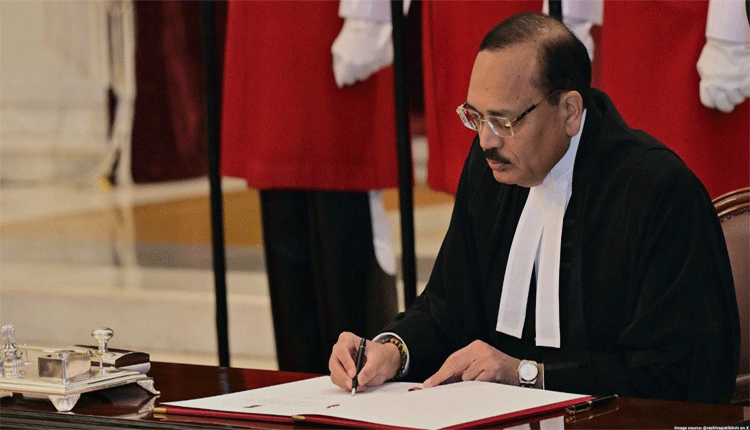
New Delhi: Expressing serious concern over the rising menace of ‘digital arrest’ scams across the country, Chief Justice of India (CJI) Surya Kant has suggested that the crime should be distinctly defined under criminal law, accompanied by stringent consequences, including the confiscation of the accused’s assets.

The Supreme Court took suo motu cognisance of the alarming surge in digital arrest cases, where fraudsters impersonate law enforcement officials over video or audio calls to extort money from unsuspecting victims. During the hearing, CJI Surya Kant indicated that the apex court would issue detailed directives regarding the matter shortly.
Emphasising the need for a stronger legal framework, the Chief Justice questioned whether a premier national agency should be tasked with investigating such cases. He further proposed formally defining ‘digital arrest’ within the ambit of criminal laws, noting that the crime inherently involves elements of extortion and robbery. CJI Surya Kant strongly advocated for provisions that would allow authorities to seize the properties of the accused once substantial evidence is found against them.
The amicus curiae assisting the court highlighted that the threat is not limited to WhatsApp but extends across all chat applications. To curb these scams in real time, the amicus suggested the implementation of a ‘kill switch’ mechanism on these platforms. Instead of a fixed one or two hour window, artificial intelligence could be deployed to determine the appropriate timing to intervene. The proposed system would involve a two step process: first, issuing a pop up warning to alert the user of a potential scam during the call, and second, activating an actual ‘kill switch’ to disconnect the call. This would provide potential victims a crucial window to pause, assess the situation, and seek help from others.
Adding to the discussion, Justice Dipankar Datta (referred to as Justice Bagchi in some reports, assuming contextual translation) raised the issue of deepfakes, which are increasingly being weaponised for fraud and impersonation. He stressed that while existing laws provide a foundation, they urgently need to be upgraded and amended to tackle modern technological crimes. However, he also noted that under Article 142 of the Constitution, the Supreme Court cannot define a new offence, a responsibility that lies with the legislature.
The Supreme Court’s proactive stance signals a significant push toward creating a robust legal and technological shield to protect citizens from the rapidly evolving landscape of cyber extortion.
Comments are closed.