

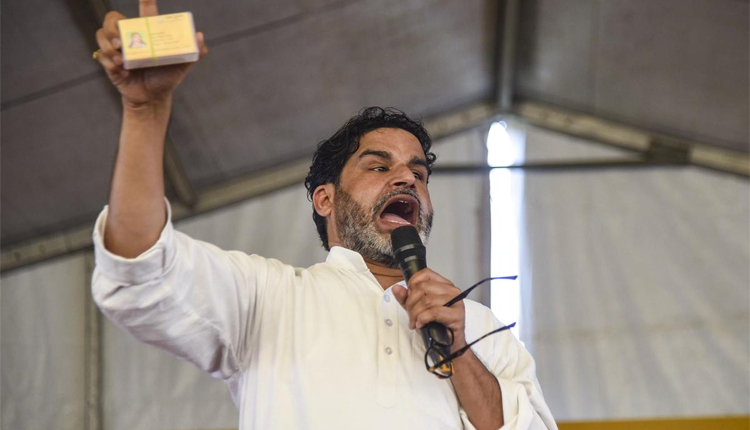
Patna: The political temperature in Bihar has surged ahead of the upcoming by-polls, with the “Jeevika Didi” network once again landing in the centre of an electoral controversy. Jan Suraaj party founder and Bankipur assembly candidate Prashant Kishor has levelled serious allegations against the ruling National Democratic Alliance (NDA), accusing them of misusing the massive self-help group network to manipulate voters.

Addressing a press conference in Patna on Sunday, Kishor issued an ultimatum to the Election Commission. He stated that if the Jeevika Didi cadres are not completely detached from the election process within 24 hours, he and his supporters will stage an indefinite sit-in protest outside the commission’s office.
Kishor alleged that NDA leaders and the local administration are weaponising the Jeevika network. According to him, rural women voters are being intimidated and threatened with the discontinuation of government benefits if they do not vote for the ruling alliance. He also questioned the role of the Patna District Magistrate, accusing the administration of actively participating in this systemic misuse.
The Jeevika Didi network, officially the Bihar Rural Livelihoods Project, is a formidable political and social force. Launched by Chief Minister Nitish Kumar with World Bank assistance, it has grown into the state’s largest organised grassroots network of women. Currently, over 1.3 million Self-Help Groups (SHGs) are active in Bihar, connecting more than 14 million women. The government aims to expand this base to 15 million members.
In these groups, usually comprising 10 to 15 women, members save money and provide low-interest loans to one another. An average Jeevika Didi earns between Rs 10,000 and Rs 25,000 monthly, and the groups have collectively availed loans worth nearly Rs 34,000 crore to date. Because they are the direct link between the government schemes and rural women, they hold immense influence in every village and panchayat.
During the previous assembly elections, similar allegations surfaced, claiming that Jeevika workers functioned as undeclared campaigners for the BJP and JDU. Critics argue that since these women distribute government grants and loans, they are used to mobilise female voters at the booth level and implicitly remind them to “stay with the government.” Both the state government and Jeevika administration have consistently rejected these claims, maintaining that the initiative is purely meant for women’s empowerment.
Kishor noted that his team has already met the Election Commission twice to file written complaints. Meanwhile, the BJP has countered by filing complaints against Jan Suraaj regarding its campaign funding and techniques. All eyes are now on the Election Commission’s response, which will determine the course of this escalating political showdown.
Comments are closed.