

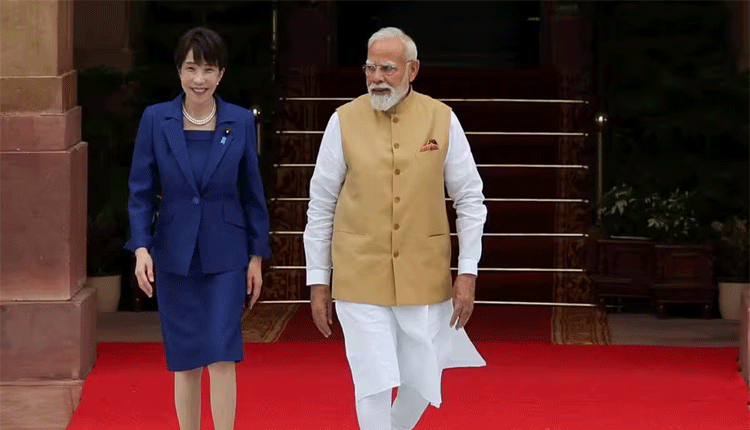
New Delhi: China has raised objections to the growing cooperation between India and Japan, a day after Prime Minister Narendra Modi and Japanese Prime Minister Sanae Takaichi announced several major initiatives during her visit to Delhi.
Beijing’s reaction came on Friday, with the Chinese Foreign Ministry saying that cooperation between countries should not target any third party or harm the interests of another nation. The remarks were made after India and Japan moved to strengthen ties in critical minerals, supply chains, defence manufacturing and energy security.
Chinese Foreign Ministry spokesperson Guo Jiakun, responding to a question on India Japan cooperation in critical minerals, said such partnerships should help build understanding and trust among regional countries and contribute to peace and stability.
“Cooperation between countries should not target any third party or damage its interests,” Guo said during a media briefing. He added that such cooperation should not be used as an excuse to create exclusive groupings or encourage division and confrontation.
Guo also said that maintaining secure and stable global industrial and supply chains is a shared responsibility of all countries. He called on all sides to promote openness and cooperation and play a constructive role in the process.
Prime Minister Modi, who has described Takaichi as his younger sister, has underlined the importance India attaches to its partnership with Japan. After their summit talks on Thursday, both sides announced an economic partnership framework, a defence agreement for joint production of military hardware and steps to deepen energy cooperation to deal with sudden fluctuations in oil prices.
China’s response also touched upon tensions in the East China Sea and South China Sea. The Chinese side expressed concern over developments in these regions and opposed unilateral actions that threaten freedom of navigation or attempt to change the status quo through force.
Beijing has been closely watching the Japanese Prime Minister’s India visit. Relations between Japan and China had touched a low point in November 2025 after Takaichi said Japan could respond if China attacked Taiwan. China considers Taiwan a breakaway province and has not ruled out the use of force to bring it under its control.
The tensions also come amid China’s tight control over rare earth exports to Japan, the United States, India and other countries. China controls nearly 70 percent of global rare earth mining and around 90 percent of processing. These minerals are crucial for electronics, automobiles, wind energy, defence equipment and several modern technologies.
The India Japan initiatives are being seen as part of a broader push to build resilient supply chains and reduce dependence on any single country for critical resources.