

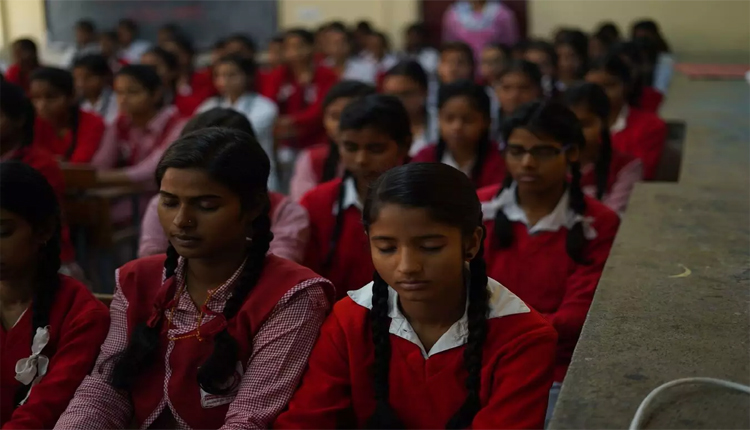
Bilaspur: In a significant ruling regarding secular principles in education, the Chhattisgarh High Court has clarified that students in government schools cannot be compelled to recite Hindu prayers. The court’s observation came during a hearing regarding a state government circular that had mandated the inclusion of specific religious verses in school assemblies.

The controversy stemmed from a circular issued by the state education department on June 12. The directive instructed government schools across the state to include the National Anthem, the National Song, the ‘Deep Mantra’, Saraswati Vandana, Guru Mantra, and Gayatri Mantra in their daily curriculum. Furthermore, it made the recital of ‘Bhojan Mantra’ during lunch and the ‘Shanti Mantra’ before school dismissal mandatory.
The circular was challenged in the High Court by a group of petitioners, including former Chhattisgarh Waqf Board Chairman Abdul Salam Rizvi, former Minority Department Chairman Mahendra Chhabra, and Bilaspur-based social activist Shafique Ahmed.
In their petition, the challengers argued that the mandatory inclusion of these specific prayers and mantras amounted to imparting religious education and promoting a particular faith, which they contended was unconstitutional and violated secular principles guaranteed under the Constitution. They further argued that the order failed to protect students who did not wish to participate in these specific religious rituals, thereby creating an unacceptable classification based on religion.
During the proceedings, Justice Amitendra Kishore Prasad took note of the state government’s submission that although the circular was issued earlier in June, it had not yet been implemented.
Based on this assurance, the High Court disposed of the petition. However, the court provided liberty to the petitioners to approach it again if any student is forced to participate in the recital of these prayers. The court further remarked that if any such compulsion is brought to its notice in the future, appropriate action will be taken.
This ruling underscores the legal stance that while schools may engage in educational activities, they must remain cautious of constitutional boundaries regarding religious neutrality, ensuring that students from diverse backgrounds are not coerced into religious practices within state-funded institutions.
Comments are closed.