

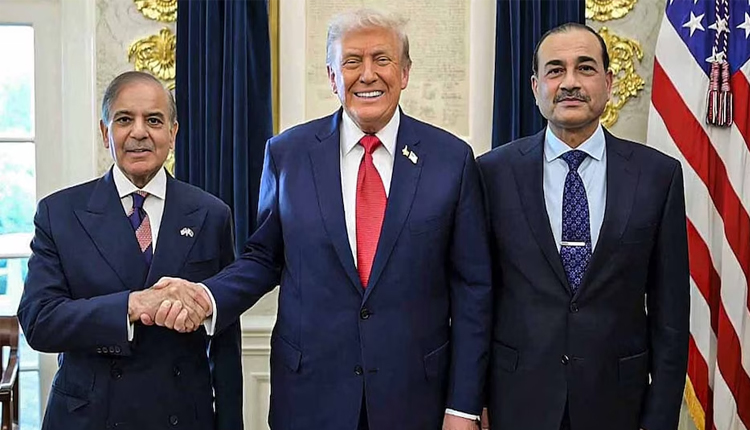
New Delhi: Pakistan’s leadership is facing a difficult diplomatic test as the United States under President Donald Trump reportedly pushes for the expansion of the Abraham Accords to include more Muslim countries, including Pakistan. According to an Aaj Tak analysis, the pressure has placed Pakistan Army Chief General Asim Munir and Prime Minister Shehbaz Sharif in a sensitive position, with Islamabad caught between American expectations and its long held position on Palestine.

The Abraham Accords were first signed in 2020 through American mediation between Israel and several Arab countries, including the United Arab Emirates, Bahrain, Sudan and Morocco. The objective was to normalise diplomatic, economic, defence and cultural relations with Israel. While Washington presented the agreements as a step towards peace, critics have argued that the process gave priority to Arab Israeli cooperation without resolving the Palestinian issue.
Pakistan has historically refused to recognise Israel. Its official position has been that recognition can be considered only after the creation of an independent Palestinian state based on the 1967 borders, with East Jerusalem as its capital. The report notes that Pakistan’s passport also reflects this policy, as Israel is not listed on it.
The current challenge for Islamabad is two fold. On one side, Pakistan needs economic and military support from the United States. On the other, recognising Israel or joining the Abraham Accords could trigger strong opposition from religious groups, political parties and the pro Palestine public sentiment at home.
Pakistan’s government and military establishment have so far maintained a clear public position. In October 2025, Defence Minister Khawaja Asif said Pakistan would not join the Abraham Accords and would not recognise Israel, calling it against the country’s basic ideology. Foreign Minister Ishaq Dar also said the same month that Pakistan’s policy towards Israel had not changed and would not change.
In January 2026, Pakistan’s Foreign Ministry stated that some basic conditions would need to be fulfilled before any such step, including the creation of an independent Palestinian state with East Jerusalem as its capital. The analysis says these statements show that Pakistan is not ready to abandon its traditional stand.
However, the pressure is unlikely to disappear. The report argues that Trump’s diplomacy is aggressive and is linked to Washington’s wider strategy on Iran, CPEC and regional alignments. Experts cited in the analysis believe Pakistan may avoid formally joining the Abraham Accords, but could explore limited informal engagement with Israel.
For Munir and Shehbaz, both options carry political risk. Accepting American pressure could invite domestic backlash, while rejecting it could strain ties with Washington. The Abraham Accords question has therefore become a major test of Pakistan’s foreign policy, ideology and political survival.
Comments are closed.