

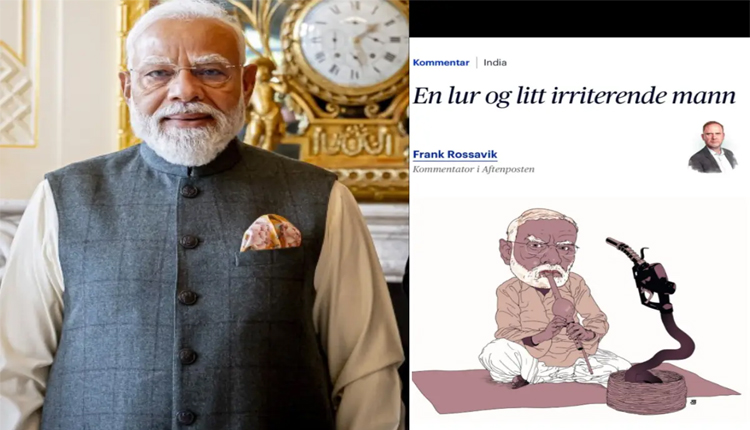
New Delhi: A major Norwegian newspaper has triggered a sharp controversy after publishing a cartoon of Prime Minister Narendra Modi that many social media users in India have described as racist and deeply stereotypical.
According to the ABP Live report, the cartoon, published on Wednesday, showed PM Modi as a snake charmer. The illustration appeared alongside an opinion piece titled “A clever and slightly annoying man.” The portrayal has drawn strong criticism online, with several users arguing that it revives an outdated Western stereotype of India as a land of snake charmers.
The controversy comes shortly after PM Modi’s visit to Norway, where journalist Helle Lyng questioned why the Prime Minister was not taking questions from the press during a joint media appearance. The issue later became a flashpoint, with Indian diplomatic representatives pushing back against what they saw as an incomplete understanding of India’s democracy and media landscape.
India’s Ambassador to Japan, Sibi George, had objected strongly to the framing of the question and said that foreign institutions often form opinions without fully understanding the scale and complexity of India. He also underlined that India, as a large democracy, cannot be judged through a narrow lens.
The cartoon has now widened the debate from press freedom to questions of racial sensitivity and cultural respect. Many Indian users on social media said criticism of a political leader is part of journalism, but reducing India’s elected Prime Minister to a snake charmer image crosses a line. Several called it an example of colonial era prejudice dressed up as commentary.
The timing of the cartoon has added to the anger. PM Modi has often said that the world once viewed India through clichés such as snake charmers, but the country has now emerged as a major global force in technology, economy, diplomacy and innovation. For many critics, the cartoon appeared to ignore that transformation and fall back on an old, insulting visual trope.
The row also comes against the larger backdrop of international debate around press freedom. Norway is often placed at the top of global press freedom rankings, while India has faced questions from foreign media and rights groups over the issue. However, the latest controversy shows how a debate on media freedom can quickly become charged when representation, race and national dignity enter the frame.
As the outrage grows online, the episode has become more than a dispute over one cartoon. It has raised a larger question: can global media criticise powerful leaders without leaning on tired cultural stereotypes? For many Indians reacting to the image, the answer is clear. Political satire is welcome, but racism cannot be its language.
Comments are closed.