

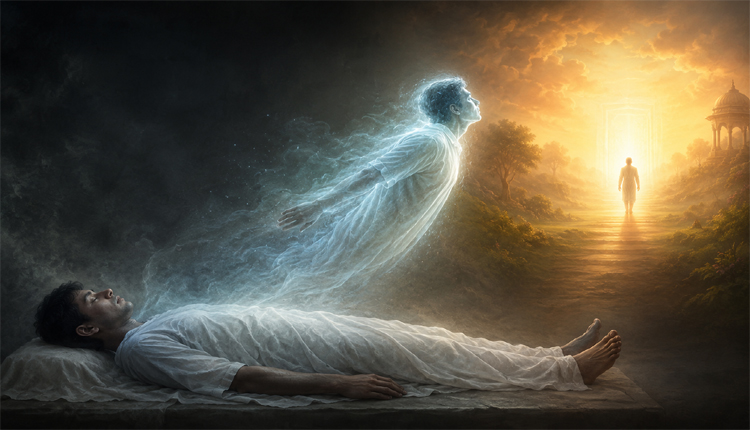
New Delhi: What happens after death? Does everything end with the body, or does something deeper continue its journey? This question has troubled human beings for centuries, and Indian philosophy has long offered a profound answer to it.
According to an ABP Live report, the Vedas, Upanishads and the Bhagavad Gita describe death not as the end of consciousness, but as the end of the physical body. The report explains that Sanatan philosophy believes the soul moves ahead with the subtle powers of the mind and the five senses after leaving the body.
Indian thought broadly speaks of three layers of human existence. The first is the physical body, which is visible and perishable. The second is the subtle body, which includes the mind, intellect, life force and sensory powers. The third is the causal body, where karma and impressions are believed to remain. At death, the physical body comes to an end, but the subtle body is said to continue its journey.
The Bhagavad Gita explains this idea through a powerful metaphor. Lord Krishna says that just as the wind carries fragrance from flowers, the living being carries the mind and senses while leaving one body and moving to another. Here, the reference is not to physical organs like eyes, ears or tongue, but to the subtle capacities through which a person sees, hears, feels and desires.
Sanatan philosophy identifies five organs of knowledge. These are the eyes for seeing, ears for hearing, nose for smell, tongue for taste and skin for touch. The belief is that their subtle tendencies remain with the soul even after the body is gone, shaping future experiences and spiritual direction.
The report also underlines why the mind holds such importance in Indian spiritual thought. Ancient seers described the mind as both the cause of bondage and the path to liberation. This is why yoga, meditation, chanting and spiritual discipline are seen not only as rituals, but as ways to purify the mind.
The idea has gained fresh attention at a time when modern science is studying consciousness, human mind and near death experiences. Some people who have come close to death have claimed awareness of events around them even when their bodies were medically inactive. Science has not reached a final conclusion, but consciousness remains one of its most intriguing questions.
Indian philosophy, however, has always treated consciousness as something larger than the body. The Katha Upanishad presents death not merely as an ending, but as a doorway. It says fear of death arises when human beings identify themselves only with the body.
In today’s fast moving and mentally stressful world, this teaching carries a quiet message. Wealth, position and fame may be left behind, but according to Indian belief, one’s nature, impressions and consciousness become the basis of the next journey.
Perhaps that is why the sages said that one should know the self before death. For the one who understands the self, death is no longer just an end. It becomes the beginning of another journey.

Comments are closed.