

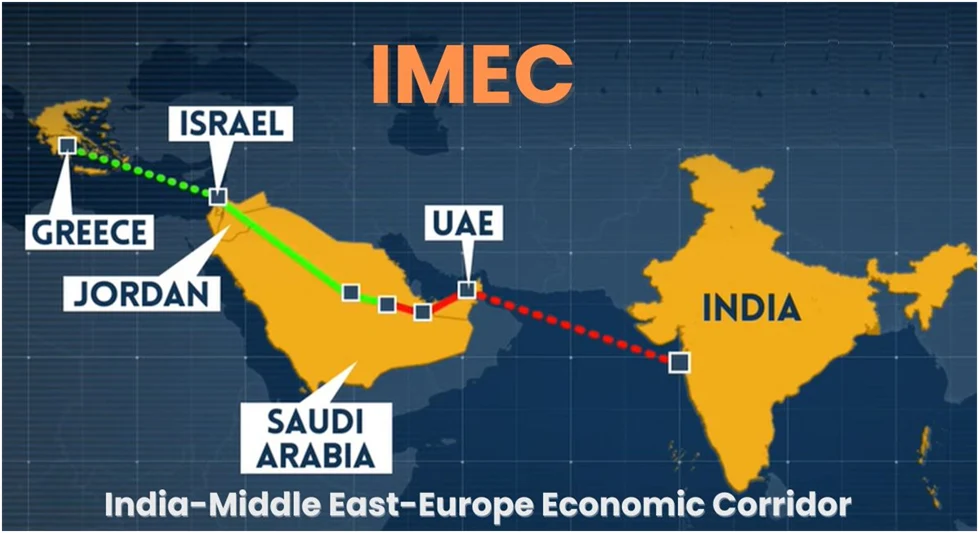
New Delhii: While ships continue to dodge missiles and drones in the turbulent Red Sea, India is quietly sharpening a powerful alternative that could reshape global trade routes forever — the India-Middle East-Europe Economic Corridor (IMEC).

Announced with much fanfare at the 2023 G20 Summit in Delhi, this ambitious multimodal project links India’s ports to the UAE by sea, then races across rail networks through Saudi Arabia, Jordan, and Israel before reaching European shores. It is not just another trade highway; experts see it as India’s smart insurance policy against the chaos of chokepoints like the Bab el-Mandeb Strait and Strait of Hormuz, which together handle a massive chunk of the world’s oil and goods.
The ongoing Red Sea crisis, now stretching into its 18th month in April 2026, has made the urgency crystal clear. Rerouting around Africa adds 14-20 days and shoots up costs by 15-20 per cent or more, hitting insurance premiums hard and slowing everything from electronics to energy supplies. For India, where nearly 95 per cent of trade still sails the seas, such disruptions mean higher prices at home and lost opportunities abroad.
IMEC promises to cut transit time to Europe by up to 40 per cent in ideal conditions, slashing logistics expenses while carrying not only goods but also energy resources and even digital data cables. It cleverly blends sea and rail to bypass the most vulnerable maritime stretches, offering a more secure and reliable path.
Beyond economics, the corridor carries deep strategic weight. It stands as a counterweight to China’s Belt and Road Initiative, positioning India at the heart of a cleaner, friendlier connectivity network involving the UAE, Saudi Arabia, Jordan, Israel, and Europe. A recent report from the International Centre for Peace Studies in New Delhi argues that today’s geopolitical tensions are actually a golden window for India to fast-track IMEC and turn vulnerability into strength.
Of course, challenges remain — regional instability, the need for heavy investment, and diplomatic balancing acts. Yet the message is loud: when traditional sea lanes tremble, India’s IMEC plan offers a steady new heartbeat for trade and security. In these uncertain times, building resilient corridors may prove wiser than simply hoping the storms pass.
Comments are closed.