

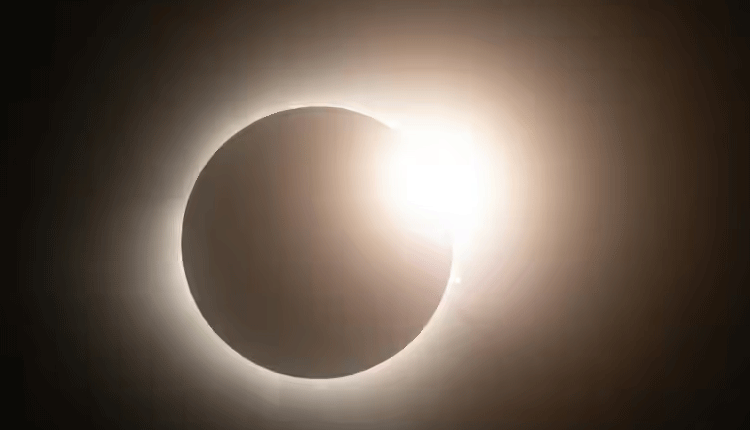
New Delhi: The year 2027 is set to offer skywatchers an eventful celestial calendar featuring five eclipses, comprising two solar and three penumbral lunar eclipses. Among these astronomical events, the total solar eclipse on August 2 will serve as the premier attraction, offering partial visibility across several regions of India.

The astronomical sequence begins on February 6 with an annular solar eclipse. During this phase, the Moon will align directly between the Earth and the Sun but will not cover the solar disc entirely, creating the characteristic “ring of fire” phenomenon. However, this spectacle will not be visible from Indian territory. It will be followed on February 21 by the first lunar event of the year, a penumbral lunar eclipse. In this configuration, the Moon glides through the faint outer rim of Earth’s shadow, resulting in a subtle reduction in lunar brightness rather than a dramatic reddish hue.
The middle of the year will bring the third event on July 18, marked by another penumbral lunar eclipse that will cause only minor, often imperceptible shifts in illumination.
Astronomers regard the August 2 total solar eclipse as the defining event of 2027. The Moon will obscure the Sun completely along the path of totality, plunging regions across Spain, Morocco, Algeria, Tunisia, Libya, Egypt, and Saudi Arabia into brief daytime darkness. Skywatchers in India will be able to witness a partial phase of this eclipse. The annual cycle will draw to a close on August 17 with the third penumbral lunar eclipse.
Optical safety remains a primary concern for observers. Experts warn that looking directly at the Sun during any phase of a solar eclipse without proper protection can lead to severe retinal damage or permanent vision loss. Astronomers stress that ordinary sunglasses offer zero protection, urging the public to view the event strictly through certified solar filters or ISO-compliant eclipse glasses. In contrast, lunar eclipses carry no such risk and can be observed safely with the naked eye.
From a cultural perspective, traditional beliefs associate eclipses with the Sutak period, which conventionally commences 12 hours prior to a solar eclipse and nine hours before a lunar eclipse. Scholars emphasize that Sutak restrictions on auspicious activities and food preparation apply only to localities where the eclipse is physically visible, making consultation with regional panchang calendars necessary.