

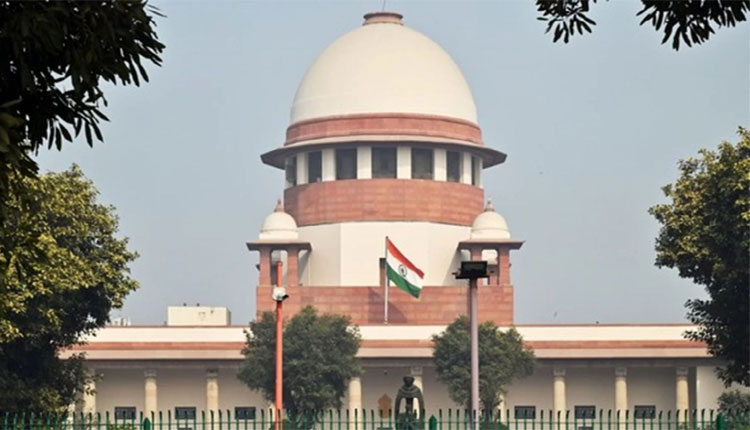
New Delhi: The Supreme Court is currently hearing a crucial petition filed by the Muslim side regarding the disputed Bhojshala complex in the Dhar district of Madhya Pradesh. The petitioners have approached the top court alleging that the state government and local administration have failed to comply with earlier judicial directives regarding the allotment of alternative land for Friday prayers.

The legal battle revolves around a previous Supreme Court order issued on July 14. The court had clearly directed the Madhya Pradesh government to ensure a separate open space is provided near the disputed Bhojshala premises. This interim measure was meant to allow the peaceful conduct of Friday prayers between 1 PM and 3 PM until a final verdict is reached in the ongoing civil dispute.
During the hearing on Thursday, Senior Advocate Huzefa Ahmadi, representing the Muslim side, strongly criticised the approach of the local authorities. He informed the bench that the administration had completely ignored the spirit of the court orders. Ahmadi stated that the district collector had assigned a location situated 1.3 kilometres away from the original site. He further added that the collector had strictly ordered that only this distant location would be permitted for the prayers.
Representing the state government, Solicitor General Tushar Mehta attempted to address the concerns by informing the court that local authorities had convened another meeting and identified a fresh location. However, this proposal was swiftly rejected by Ahmadi. He argued to the court that the newly suggested site was not only too far but also located within the premises of a brewery.
Instead of accepting the state proposals, the petitioners put forward their own suggestion. They appealed to the court to grant them a vacant plot of land located right in front of a nearby Dargah. Standing firm on their demands, the petitioners stressed that they should not be compelled to submit to the dominance of any particular community.
A Supreme Court bench comprising Justice Surya Kant, Justice Joymalya Bagchi, and Justice V Mohana is presiding over the matter. The ongoing proceedings highlight the delicate challenge of preserving religious rights and ensuring administrative compliance while maintaining law and order in the historically sensitive region.
Comments are closed.