

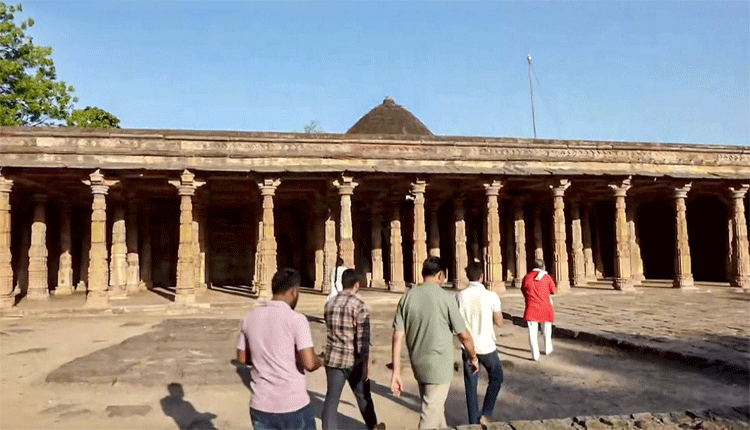
New Delhi: The Supreme Court of India is currently hearing a plea filed by the Muslim side concerning the disputed Bhojshala site in Dhar, Madhya Pradesh. The petitioners have alleged non compliance with earlier court directives to provide alternative land for Friday prayers (Jumma Namaz) near the disputed premises.

The matter was brought before a bench comprising Chief Justice Surya Kant, Justice Joymalya Bagchi, and Justice V. Mohana. The hearing, initially scheduled for Wednesday, was deferred to Thursday after the bench rose early the previous day.
Appearing for the Muslim side, Senior Advocate Huzefa Ahmadi informed the apex court that its earlier orders were being ignored. “Your orders are not being complied with. The place allotted is 1.3 kilometres away, and the collector has ordered that only this site will be assigned,” Ahmadi stated. He expressed strong objections to the newly proposed site, pointing out that it is not only too far but also forms part of a brewery.
During the proceedings, the Chief Justice questioned Solicitor General Tushar Mehta, representing the state government, on why the petitioners were not informed about an appropriate alternative space. Mehta responded by stating that the administration had met again and identified another location.
However, Ahmadi rejected the new proposal, suggesting instead that a vacant plot of land in front of a Dargah situated near the Bhojshala site could be allotted for prayers. The petitioners stressed that they should not be forced to bow down to the high handedness of any one community.
Earlier, on July 14, the Supreme Court had directed the state government to provide a separate open space near the disputed Bhojshala complex for Friday prayers between 1 PM and 3 PM. This interim arrangement was ordered to remain in place until the final disposal of the case. The ongoing legal battle continues to draw significant attention as the court navigates the complexities of ensuring religious rights while maintaining law and order in the sensitive region.
Comments are closed.