

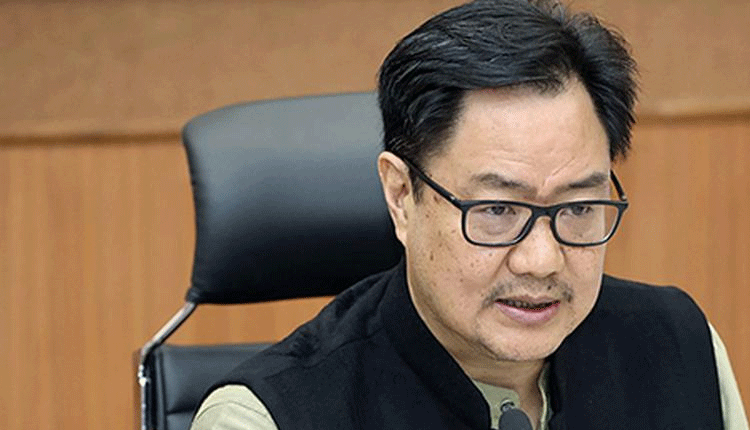
rinagar: Union Minister for Parliamentary Affairs and Minority Affairs Kiren Rijiju on Monday stated that the effective management and utilisation of more than nine lakh Waqf properties across the country hold the potential to bring about a sweeping socio-economic transformation for the Muslim community, particularly its poorest sections.

Speaking to journalists on the sidelines of an event at the Sher-e-Kashmir University of Agricultural Sciences and Technology (SKUAST) in Srinagar, the Minister emphasized that Waqf assets are intended to function as instruments of public welfare and community upliftment rather than remaining mired in administrative inefficiency.
“There are more than nine lakh Waqf properties in the country. If all these Waqf properties are effectively utilised for the welfare of the Muslim community, it can transform the entire situation of the community,” Rijiju said, pointing out that impoverished and vulnerable families would be the primary beneficiaries of transparent asset administration.
Rijiju commended the Jammu and Kashmir Waqf Board, headed by Chairperson Darakhshan Andrabi, describing its institutional functioning as among the best in the country. He noted that the board’s recent initiatives in healthcare, skill development, and education—including the newly inaugurated Bibi Haleema College of Nursing and Medical Technology at Kathidarwaza—directly benefit common citizens and pilgrims visiting prominent shrines like Hazratbal.
Addressing the controversy surrounding the Waqf Amendment Act, the Minister accused political opponents of attempting to mislead the public through misinformation campaigns. He asserted that the legislative revisions were drafted with the sole intent of ensuring transparency, robust accountability, and efficient dispute resolution.
“We do not take criticism badly; in a democracy, everyone has the freedom to speak. However, at that time, I had promised in Parliament that after the new Waqf law comes into effect, the management of Waqf properties in the country would improve significantly,” Rijiju reiterated. He added that the law does not aim to harass any community, aligning with the Centre’s broader vision of inclusive growth to ensure every segment of society progresses collectively.