

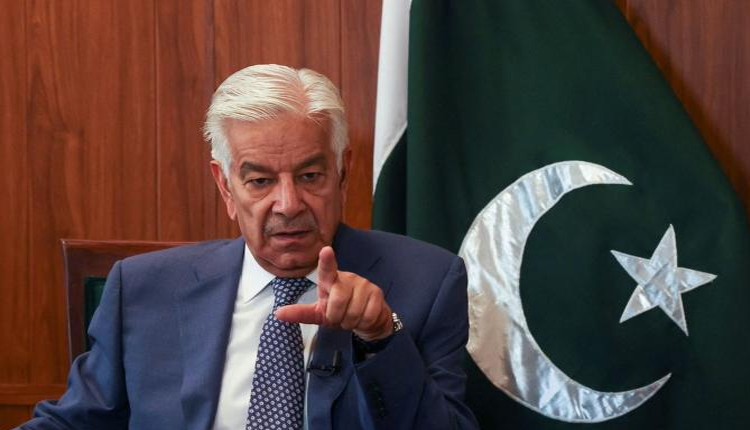
New Delhi: Pakistan Defence Minister Khawaja Asif has triggered a fresh debate inside Pakistan after openly questioning the way history is taught in the country and admitting that generations of students have been kept away from parts of their civilisational past. His remarks have brought the issue of identity, ancestry and historical distortion back into public discussion.

In an interview, Asif said Pakistani Muslims often distance themselves from their Hindu ancestors and that many people falsely claim that their forefathers came from Saudi Arabia or Iran. He argued that this mindset was deliberately created to disconnect Pakistan’s younger generation from its original cultural roots.
Asif also questioned the treatment of ancient Indian rulers in Pakistan’s history books. He said figures such as Chandragupta Maurya and Emperor Ashoka were largely removed from textbooks because they were Hindu. Asking a direct question about identity, he said his ancestors were Hindu and asked whether that made him any less Pakistani.
The Pakistani Defence Minister further alleged that history books in the country were written by people who wanted to shape future generations in a particular ideological direction. According to him, children in Pakistan are not being taught factual history, and many students today do not even know who Chandragupta Maurya and Ashoka were.
Asif also linked the rewriting of history with Pakistan’s political and strategic choices. He claimed that society’s thinking was changed in a way that allowed Pakistan to be used in America’s wars, and that history was presented to support that larger mindset.
His comments come at a time when he is already facing political heat over Pakistan’s position on Israel and the Abraham Accords. US President Donald Trump has urged several Muslim countries, including Pakistan, to join the Abraham Accords and normalise ties with Israel as part of a broader regional strategy linked to Iran diplomacy.
Asif has maintained that Pakistan should not join any agreement that goes against its basic ideology. Islamabad has historically refused to recognise Israel and has insisted that recognition can be considered only after the creation of an independent Palestinian state based on the 1967 borders, with East Jerusalem as its capital.
The controversy has also drawn reaction in the United States. Republican Senator Lindsey Graham questioned Pakistan’s possible role in Iran related mediation, calling it problematic because of Islamabad’s long standing position towards Israel.
Asif’s remarks have now opened two parallel debates: one over Pakistan’s historical identity and another over its foreign policy direction. Both issues are sensitive, and his comments may continue to generate political discussion in Pakistan and beyond.
Comments are closed.