

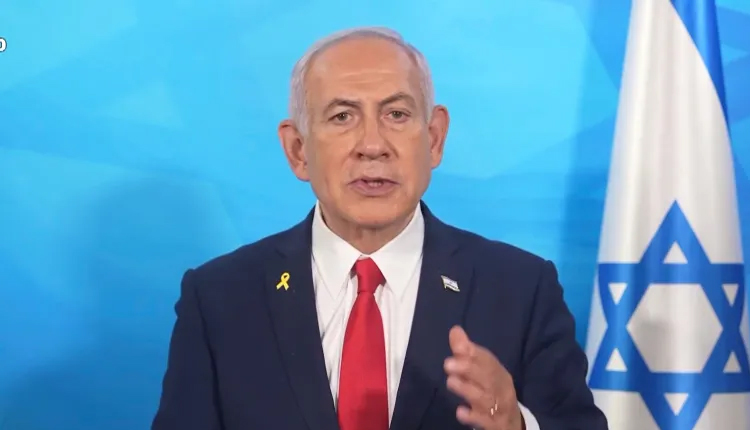
Tel Aviv: As Israel gears up for its general elections on October 27, the political survival of Prime Minister Benjamin Netanyahu hangs in the balance. With 120 seats up for grabs in the Knesset (the Israeli parliament), any political party or alliance requires the support of at least 61 lawmakers to form a government. Given the deeply divided political landscape, analysts predict a fierce contest that could lead to multiple coalition equations.

Recent surveys indicate a tight race. Netanyahu’s religious-nationalist bloc is projected to secure around 50 seats, while the opposing alliance is slightly ahead with an estimated 52 seats. Under Israel’s proportional representation system, parties must secure a minimum vote share of 3.25 percent to enter the parliament. With neither side currently projected to reach the absolute majority mark, Arab parties—expected to win roughly 13 seats—could emerge as the ultimate kingmakers.
Political observers have mapped out several potential outcomes following the vote. Despite trailing in opinion polls, Netanyahu’s Likud party might still manage to form a government by consolidating support from long-time allies, including Itamar Ben-Gvir’s Otzma Yehudit, Bezalel Smotrich’s Religious Zionism, and ultra-Orthodox factions like Shas.
Conversely, the opposition has a strong chance of unseating the incumbent Prime Minister. A broad anti-Netanyahu coalition featuring former military chief Gadi Eisenkot, Yair Golan, Avigdor Lieberman, Naftali Bennett, and Yair Lapid has agreed to work together. However, they will need additional numbers to cross the halfway mark.
This is where the Arab party Ra’am, led by Mansour Abbas, becomes crucial. Abbas has not ruled out supporting the opposition alliance, provided his demands regarding housing policies and tackling organized crime in Arab communities are met. Another possibility is the formation of a minority government that survives on external legislative support.
If all coalition talks fail, the country could see a National Unity government. Such arrangements bring fierce political rivals together during national crises, similar to the short-lived 2020 alliance between Netanyahu and Benny Gantz. Leaders might also negotiate a rotational prime ministership agreement to break the deadlock. If none of these eight equations materialize, Israel could be forced into holding yet another round of snap elections.