

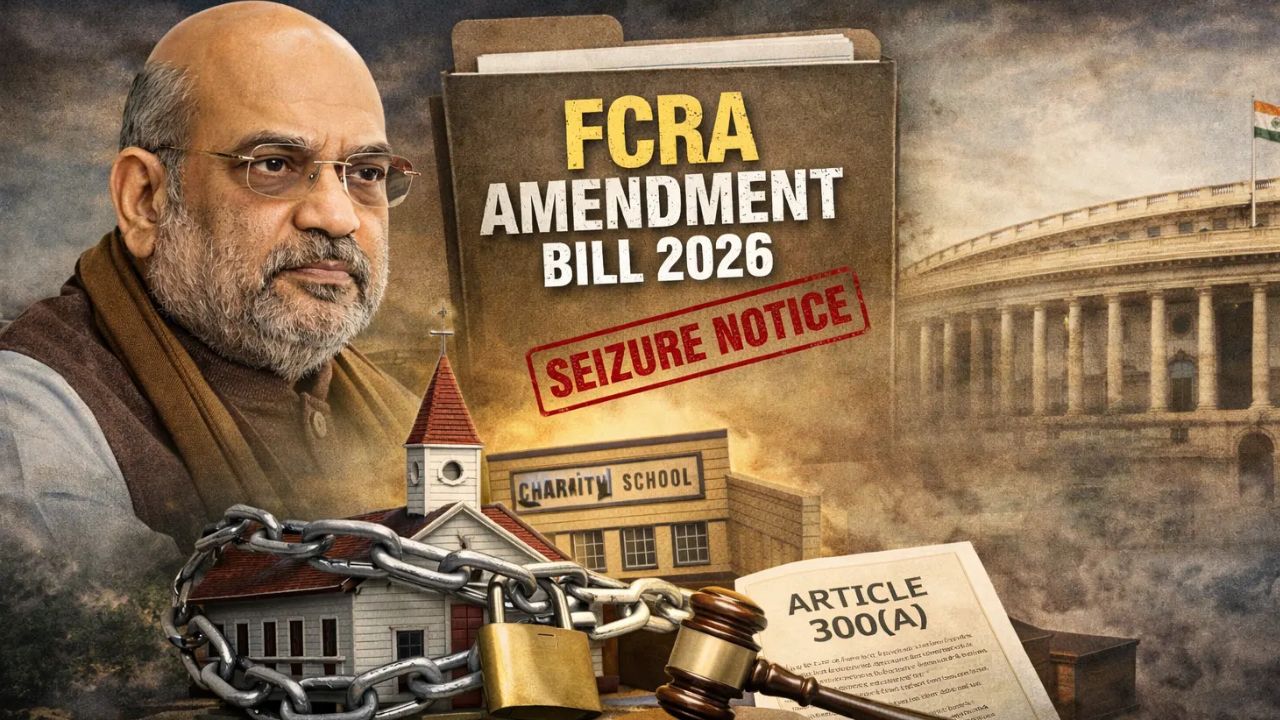
New Delhi: The proposed Foreign Contribution Regulation Amendment Bill 2026 has sparked intense political and social debate across India. Several Christian and Muslim organizations have expressed deep concerns, fearing the new legislation could pose a significant threat to their schools, hospitals, and charitable institutions.

At the center of the controversy is a provision regarding asset management. Under the proposed bill, if the FCRA registration of an institution is canceled, surrendered, or not renewed, assets created using foreign funds will automatically be transferred to a government appointed designated authority. This authority will manage the assets and can permanently retain them if the registration is not restored within a stipulated timeframe. This rule applies even to assets built using a mix of domestic and foreign donations.
During a meeting with Christian delegations on August 6, Union Home Minister Amit Shah clarified that the proposed law is entirely secular and not targeted at any specific community. Shah assured the representatives that the government has no intention of harassing any religious group. In a separate discussion with Mizoram Chief Minister Lalduhoma, Shah confirmed that the amendment bill will not be implemented retrospectively.
The Catholic Bishops Conference of India, along with various Muslim trusts operating orphanages and educational institutions, remain apprehensive as many of their establishments rely heavily on foreign contributions. However, the government maintains that the law aims at regulatory transparency rather than religious targeting. Officials noted that Christian organizations receive less than 15 percent of total foreign contributions, weakening the argument that they are being singled out.
Interestingly, major Hindu religious bodies and Sikh organizations like the Shiromani Gurdwara Parbandhak Committee have not voiced any public objections to the bill so far. Government supporters emphasize that the law applies uniformly to all Non Governmental Organizations and religious institutions across the country.
According to data from the Ministry of Home Affairs, out of 52,156 entities registered under FCRA nationwide, only 14,434 remain active today. Tamil Nadu currently leads the country in FCRA related activities, reporting the highest number of active organizations as well as the highest number of cancellations.
The bill, which also reduces the maximum punishment for FCRA violations from five years to one year, is scheduled for parliamentary discussion on August 12, just before the monsoon session concludes.
Comments are closed.