

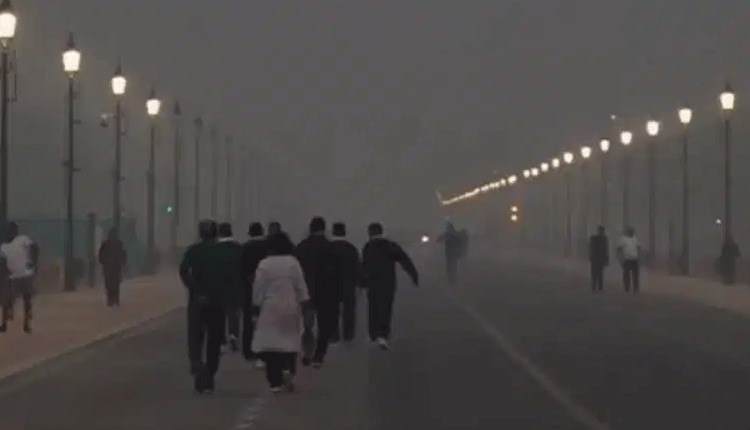
New Delhi: Ahead of the Diwali festivities, the Commission for Air Quality Management (CAQM) has enacted Stage III of the Graded Response Action Plan (GRAP) across the Delhi-National Capital Region (NCR). Implemented with immediate effect on Friday, this decision comes as a preemptive measure to combat rapidly deteriorating air quality and alarming pollution levels across the region.

The drastic step was necessitated after Delhi’s average Air Quality Index (AQI) dropped to a concerning 382, firmly placing it in the ‘very poor’ category. However, several individual monitoring stations presented an even bleaker picture, recording AQI levels in the ‘severe’ zone. Central Pollution Control Board (CPCB) data revealed that areas like IIT Delhi and Rohini recorded hazardous AQI levels of 474, while Punjabi Bagh and RK Puram stood at 465 and 443, respectively.
Meteorological predictions have further intensified these concerns. Forecasts by the India Meteorological Department (IMD) and the Indian Institute of Tropical Meteorology (IITM) indicate that near-zero wind speeds and festival-related emissions could push the capital’s air quality into the ‘severe’ category between November 7 and 9.
With GRAP Stage III now operational, stringent restrictions have been imposed across Delhi, as well as adjoining NCR districts in Haryana, Uttar Pradesh, and Rajasthan. Key measures include a strict ban on dust-generating construction and demolition activities. Additionally, operations of stone crushers, mining activities, and hot-mix plants not using approved clean fuels will be shut down. Restrictions have also been placed on the movement of specific vehicles and the use of diesel generator sets, except for essential services.
Delhi’s Environment Minister, Manjinder Singh Sirsa, appealed to the public for cooperation amid the worsening crisis. “I urge the residents of Delhi to take note: the weather is expected to worsen starting tomorrow, with wind speeds likely to drop to near-zero. I request everyone’s cooperation in adhering to these restrictions; only by working together can we help clean the air in Delhi,” Sirsa stated.
Furthermore, authorities have been empowered to decide whether government and private offices should transition to a 50 per cent work-from-home model to reduce vehicular emissions. As the capital braces for Diwali, these stringent curbs reflect an urgent effort to mitigate the impending public health hazard.