

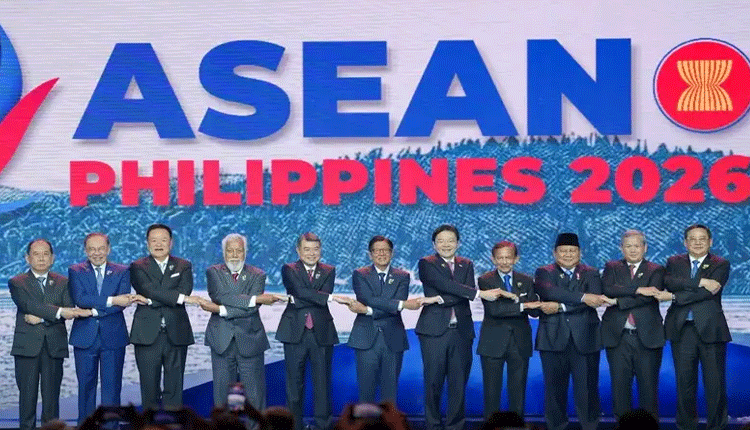
New Delhi: As the strategic competition between the United States and China intensifies, India is aggressively pivoting towards the Association of Southeast Asian Nations (ASEAN) to solidify its trade and geopolitical footprints. With the ASEAN bloc now encompassing 11 member states, a collective population of approximately 700 million, and a combined economic scale of nearly $4 trillion, the region has undeniably emerged as a primary cornerstone of New Delhi’s contemporary foreign policy.

However, the pursuit of stronger regional integration brings complex economic hurdles to the forefront. According to official trade statistics for the financial year 2025-26, total bilateral trade between India and the ASEAN bloc touched $128.38 billion.
The trade dynamics reveal a persistent imbalance: while India imported goods worth $89.96 billion, its exports lingered at $38.41 billion, burdening the nation with a massive trade deficit of $51.55 billion. To address this widening trade chasm, Indian policymakers are advocating for a swift and comprehensive review of the ASEAN-India Trade in Goods Agreement (AITIGA). Officials emphasize that overhauling this free trade framework is vital to create a level playing field, grant Indian enterprises unhindered market access, and protect domestic industries from skewed trade rules. Beyond the economic calculus, maritime security in the Indo-Pacific remains a critical driver for New Delhi’s engagements. The South China Sea continues to be a volatile flashpoint, exacerbated by Beijing’s sweeping territorial claims and friction with ASEAN nations such as the Philippines, Vietnam, Malaysia, and Brunei.
Although China and ASEAN have reportedly agreed on nearly 80 percent of a proposed maritime Code of Conduct, serious divisions remain regarding the legally binding nature of the pact. In response, India maintains a firm diplomatic stance, championing a rules-based order. New Delhi consistently asserts that all territorial disputes must be amicably resolved under the United Nations Convention on the Law of the Sea (UNCLOS).
By demanding guarantees for freedom of navigation and secure commercial maritime routes, India aims to protect its vital international supply chains. Ultimately, as Washington and Beijing vie for regional hegemony, India’s calculated outreach to ASEAN serves a dual purpose. By addressing massive trade deficits and championing maritime sovereignty, New Delhi is actively cementing its role as a pivotal and stabilizing counterweight in the Asia-Pacific theater.