

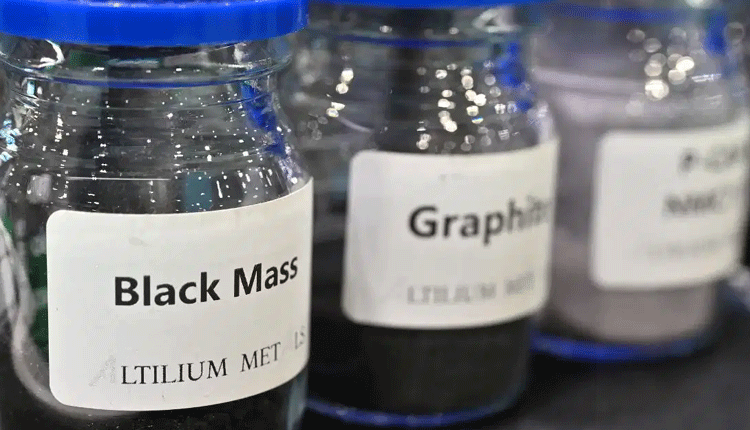
New Delhi: In a strategic move to secure critical minerals for domestic use, the central government has imposed an immediate ban on the export of ‘black mass’ derived from lithium-ion batteries. This pivotal decision aims to bolster India’s battery recycling capabilities and provide a significant fillip to the rapidly growing electric vehicle (EV) and energy storage sectors.

The Directorate General of Foreign Trade (DGFT), operating under the Commerce Ministry, issued a notification late Tuesday night modifying the export policy for lithium-ion battery black mass from ‘free’ to ‘restricted’. This directive will remain in force until further orders.
For the uninitiated, ‘black mass’ is a dark, powdery substance generated by shredding and processing end-of-life lithium-ion batteries and manufacturing scrap. It is a highly valuable resource, rich in critical minerals such as lithium, cobalt, nickel, and manganese, which can be extracted and repurposed for manufacturing new batteries.
According to the Commerce Ministry, India currently relies heavily on imports to meet its critical mineral requirements. While the nation’s domestic capacity to extract minerals from battery waste has improved, local recycling firms have been operating below their optimal capacity due to a severe shortage of raw materials. Ironically, a large portion of domestically generated black mass was previously being exported, forcing Indian recyclers to import the same material at a premium to sustain their operations. The new restriction ensures that local recycling units will now have adequate access to this crucial raw material.
This export ban aligns seamlessly with the government’s broader vision under the National Critical Minerals Mission (NCMM). In September 2025, the Union Cabinet approved a Rs 1,500 crore incentive scheme designed specifically to promote the extraction of critical minerals from battery and electronic waste. The government intends for this scheme to encourage fresh investments and generate employment within the recycling sector.
Industry experts anticipate that retaining black mass within the country will significantly accelerate ‘urban mining’—the process of recovering useful materials from discarded electronic products. By enhancing the domestic availability of lithium, cobalt, and nickel, India is taking a major step towards building a robust, self-reliant supply chain for the EV industry, reducing its massive import dependency, and fostering a sustainable circular economy.