

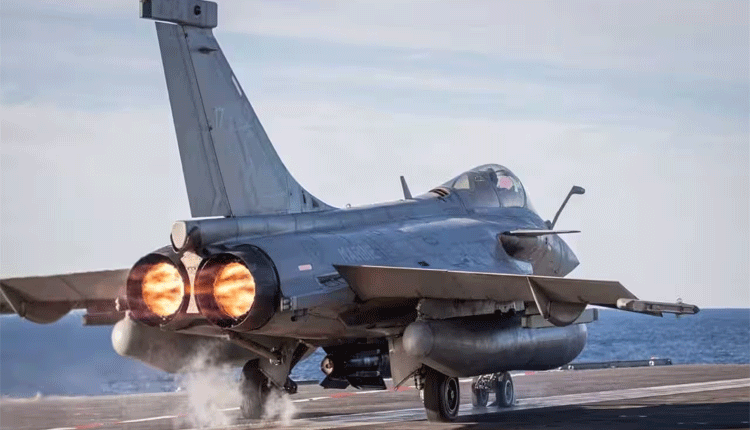
Panaji: In a significant stride toward strengthening India’s maritime security, the marine version of the Rafale fighter jet, the Rafale-M, is currently undergoing its final operational trials at the Indian Navy’s aviation base, INS Hansa, in Goa.

The development was first brought to public attention by former Navy Chief Admiral Arun Prakash, who recently shared a photograph of the Rafale-M soaring above the Goan skies on social media. Following the successful completion of these crucial trials, French aviation manufacturer Dassault will commence the dedicated production of these carrier-borne fighters for India.
These operational trials stem from a major inter-governmental agreement finalised between New Delhi and Paris in April last year, valued at approximately Rs 63,000 crore. The Defence Ministry has confirmed that the Indian Navy will procure 26 Rafale-M aircraft, comprising 22 single-seater combat jets and four twin-seater trainers that can be seamlessly adapted for fighter roles if required. According to ministry outlines, Dassault is scheduled to begin deliveries by mid-2028, with the entire fleet expected to be handed over by 2030.
The advanced fighters are urgently earmarked for deployment on INS Vikrant, India’s first indigenous aircraft carrier. Commissioned by Prime Minister Narendra Modi in September 2022, INS Vikrant currently operates without its own dedicated fleet of modern maritime strike aircraft. The warship has been temporarily relying on Russian-origin MiG-29K fighters periodically reassigned from INS Vikramaditya.
Naval strategists assert that securing the vast 70-million-square-kilometre expanse of the Indian Ocean Region requires the rapid aerial response capabilities that only carrier-strike groups can provide. The introduction of the Rafale-M is expected to permanently fill this critical operational void.
Furthermore, in a major push for the ‘Aatmanirbhar Bharat’ (Self-Reliant India) initiative, the Defence Ministry has mandated the integration of indigenous weapon systems onto the imported jets. Unlike the Indian Air Force’s land-based Rafales—which rely heavily on European MBDA missiles such as the Meteor and SCALP—the naval Rafale-M fleet will be armed with domestically produced Astra beyond-visual-range (BVR) air-to-air missiles and the formidable BrahMos anti-ship missiles.
This strategic technological integration is poised to drastically enhance the Indian Navy’s aerial firepower above the sea, ensuring a formidable deterrent posture in an increasingly contested maritime domain.