

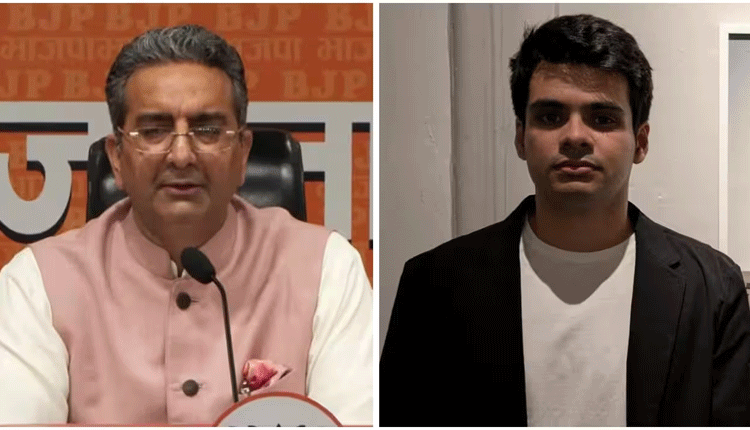
New Delhi: A fierce political row has erupted over the removal of several photographs from an exhibition by Raihan Vadra, son of Congress leader Priyanka Gandhi Vadra, at Bikaner House. The Bharatiya Janata Party (BJP) has launched a scathing attack on Priyanka Gandhi, accusing her of spreading misinformation and attempting to use the controversy to launch her son into politics.

The dispute started when Raihan Vadra alleged that the management of Bikaner House ordered the removal of dozens of his photographs—primarily documenting recent public protests—just hours before his solo exhibition was scheduled to open. The venue management cited their official policy, which strictly prohibits the display of political content. Raihan called the abrupt removal a heartbreaking experience, noting that the exhibition was the culmination of three years of hard work.
Stepping in to defend her son, Priyanka Gandhi condemned the venue’s actions. She described the move as a deliberate attempt to muzzle the voices of young people, warning that if it happens to one artist today, it will happen to others tomorrow.
In response, BJP national spokesperson Pradeep Bhandari shared a video message directly challenging the Congress leader’s narrative. Bhandari argued that Bikaner House was merely following its established guidelines, which dictate that political material cannot be showcased and must be taken down immediately.
“There can be many other ways for Priyanka Gandhi Vadra to launch her son. But at least stop lying behind the shield of the tricolour,” Bhandari stated.
The BJP leader further used the incident to take a swipe at the internal dynamics of the Congress party. “The question arises whether Priyanka Gandhi has lost faith in Rahul Gandhi, which is why she now wants to launch Raihan Vadra under the cover of her lies at Bikaner House,” Bhandari alleged. He emphasised that the country is governed by the Constitution and the rule of law, not by the rules set by one family.
Meanwhile, Raihan Vadra has maintained his stance on the issue, asserting that art is inherently political and that cultural institutions should not censor creative expression based on arbitrary political preferences.