

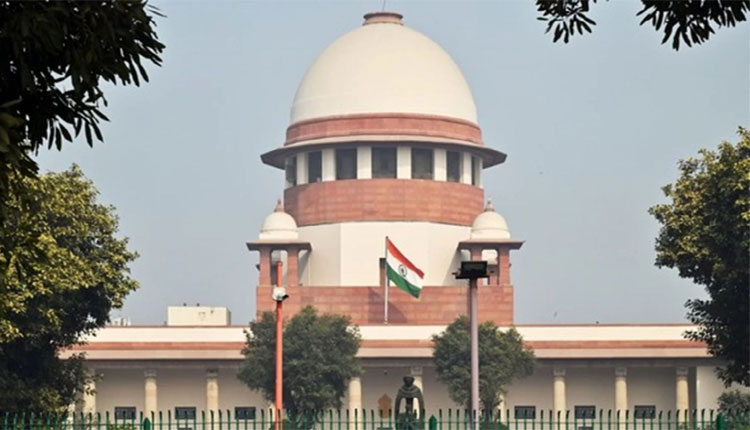
New Delhi: The controversy surrounding the modification of Form 6 for voter registration continues to deepen, with the Supreme Court questioning the Election Commission of India (ECI) over the changes made during the Special Intensive Revision (SIR) process. While the poll panel claims that an earlier order mentioned the inclusion of an additional declaration, the apex court has firmly denied granting any such approval.

During a recent hearing, Chief Justice of India (CJI) Surya Kant explicitly stated that the Supreme Court had not endorsed the revised form. “Any modified Form 6 has not been approved by us, let us be very clear. When the records are produced, we would like to see who has modified it,” the Chief Justice remarked, demanding accountability for the alterations made to the statutory document.
The dispute stems from the ECI’s decision to attach a supplementary declaration to Form 6 in states undergoing the SIR process. The Commission mandated that individuals seeking new voter registration must provide details establishing their or their ancestors’ presence in the 2003 electoral rolls, especially if their names were deleted during the revision. Those absent from the 2003 list were required to prove their eligibility through specific government documents.
Defending its stance, the Election Commission argued that it possesses comprehensive powers under Article 324 of the Constitution to prepare and amend electoral rolls. The poll body maintained that the core of Form 6 remained unchanged and that the new requirement was merely an annexure. The ECI has been citing the Supreme Court’s purported approval in its official notifications to justify the inclusion of the declaration form.
However, the Supreme Court’s categorical denial has created an unusual situation. The bench observed that while the court acknowledged the state-wide SIR as being within the Commission’s jurisdiction and not disproportionate, it had neither explicitly approved nor rejected the specific modifications to Form 6; it had merely placed them on record.
The Supreme Court is now set to examine the internal records of the Election Commission to ascertain whether the decision to modify the form was taken unanimously by all commissioners or unilaterally by Chief Election Commissioner Gyanesh Kumar. As the legal battle unfolds, the focus remains on ensuring that the constitutional body exercises its mandate strictly within the framework of laws enacted by Parliament.