

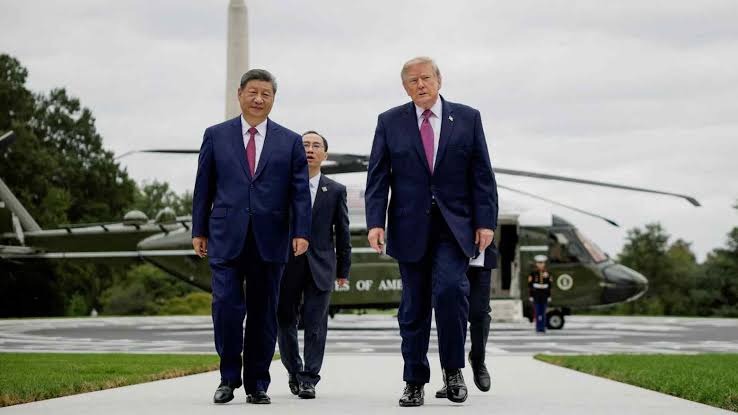
Washington: In a highly anticipated diplomatic rendezvous, US President Donald Trump and Chinese President Xi Jinping recently held a crucial meeting at the White House. The high-stakes talks centered around pressing global issues, including the ongoing trade war, rising tensions over Taiwan, strategic military competition, and the future of Artificial Intelligence (AI).

One of the most significant breakthroughs from the summit was the mutual agreement to extend their bilateral trade pact by another two months. Originally set to expire in November, this extension aims to prevent a full-blown trade war. According to US Treasury Secretary Scott Bessent, this pause will provide both nations with additional time for complex economic negotiations. However, major sticking points—such as tariffs, technology restrictions, and China’s supply of rare earth minerals—remain unresolved.
President Trump pulled out all the stops to welcome the Chinese leader, uniquely transforming the White House for the occasion. Soldiers donned vintage American military uniforms, and the iconic Rose Garden was styled reminiscent of Trump’s golf clubs. A dramatic flypast by fighter jets and bombers added to the grandeur, with the roaring engines visibly startling attendees, including Trump himself.
On the geopolitical front, Taiwan emerged as a highly sensitive topic. President Xi urged the United States to tread carefully and explicitly oppose Taiwan’s independence—a notable shift from America’s traditional stance of merely “not supporting” it. So far, the Trump administration has not indicated any changes to its diplomatic language regarding the island nation.
The leaders also addressed the looming threat of military conflict, with Xi referencing the ‘Thucydides Trap’ to describe their escalating superpower rivalry. Emphasising the need to avert a crisis, Xi advocated for robust military-to-military communication. Echoing the sentiment of historical wartime cooperation, Trump acknowledged that both nations could still collaborate on shared global interests.
Furthermore, the summit highlighted their divergent approaches to Artificial Intelligence. While Trump referred to AI as “Super Intelligence” (SI) and leaned towards relying on the Justice Department rather than imposing new regulations, Xi stressed the necessity for strict human control. The Chinese President argued that as global leaders in the AI sector, both countries must ensure the technology is developed responsibly for the broader benefit of humanity.