

New Delhi: In a groundbreaking discovery that has captured the attention of astronomers worldwide, scientists have detected unique radio signals emanating from an exoplanet located far beyond our solar system. The mysterious signals from Beta Pictoris b have sparked excitement across social media, with many wondering if it could be a message from extraterrestrial life. However, researchers have a fascinating scientific explanation for this unprecedented event.

A collaborative team of researchers from the Harvard & Smithsonian Center for Astrophysics and the University of Oregon achieved this milestone by capturing radio waves directly from the exoplanet. Previously, when such waves were detected from distant star systems, scientists struggled to pinpoint whether they originated from the host star or its orbiting planets. This precise detection marks the first time radio waves have been directly attributed to an exoplanet.
Beta Pictoris b is located approximately 63 light-years away from Earth. Discovered by NASA in 2008, this gas giant is massive—about 11.7 times heavier than Jupiter—and takes roughly 23.6 years to complete a single orbit around its host star.
While the internet buzzed with alien theories, scientists quickly clarified that the signals are not extraterrestrial messages. Instead, the radio waves are generated by massive auroras occurring in the planet’s atmosphere. Similar to Earth’s Northern and Southern Lights, Beta Pictoris b experiences auroras, but on a scale millions of times larger and more powerful. When high-energy particles from space interact with the planet’s magnetic field, they release intense bursts of radio energy.
Adding to this phenomenon is the planet’s rapid rotation. While Earth takes 24 hours to complete one rotation, Beta Pictoris b completes its day in just 8 to 9 hours. This superfast spin generates strong electrical currents, which in turn constantly emit the radio waves detected by researchers.
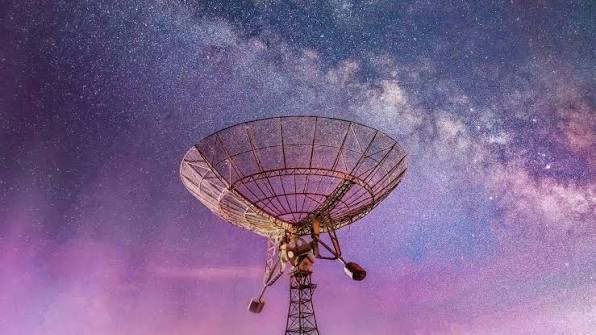
To solve the long-standing mystery of the signals’ origin, the scientific team utilized the highly powerful MeerKAT Radio Telescope Array located in South Africa. The telescope’s exceptional precision allowed scientists to filter out the background noise of the host star and isolate the small bursts of radio waves coming directly from the planet.
This discovery has also provided crucial data regarding the exoplanet’s magnetic strength. Initial calculations suggest that the magnetic field of Beta Pictoris b is an astonishing 2,500 times stronger than that of Earth. A robust magnetic field is considered essential for retaining an atmosphere and the potential possibility of life. This marks the first time scientists have directly measured the magnetic strength of a planet outside our solar system.