

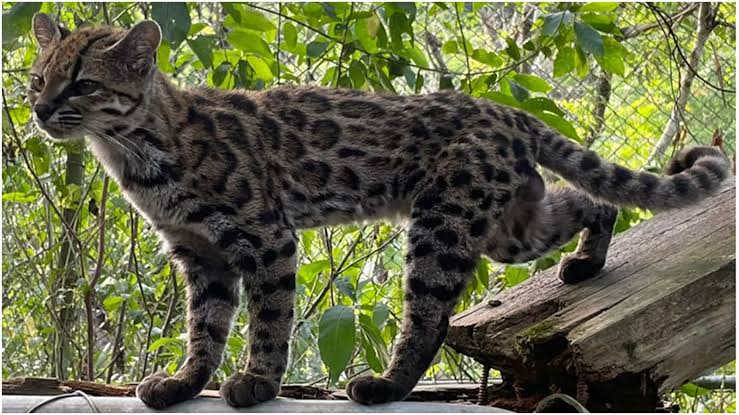
New Delhi: In a groundbreaking revelation for wildlife conservationists and researchers, scientists have identified a previously unknown species of wild cat in the cloud forests of the Bolivian Andes. This extraordinary find marks the first time in over a century that a new living feline species has been formally named and described by modern science.

The newly classified species, named Leopardus tilcayo, primarily resides in the Bolivian Yungas—a dense, mountainous region where the Andes meet the Amazon basin. Detailed in the scientific journal Current Biology, the discovery underscores how much biodiversity remains hidden in less-studied corners of the world.
Measuring merely 18 inches (46 cm) in length and weighing around 1.4 kg, the Leopardus tilcayo is noticeably smaller than an average domestic house cat. Despite its diminutive size, it sports a striking appearance with light-brown fur, short rounded ears, and irregularly shaped leopard-like rosettes.
The journey to this discovery began in 2017 when a local man found what he assumed was an abandoned domestic kitten near a forest road. After feeding it a diet of noodles and rice, he eventually realised it was a wild animal and handed it over to the Senda Verde Wildlife Sanctuary near La Paz. There, Paola Nogales-Ascarrunz, a National Geographic Explorer and wild cat conservationist, noticed the feline’s unique characteristics.
“I saw this cat, it was really, really small, and I couldn’t believe how small it was. I thought it was a kitten,” Nogales-Ascarrunz stated, noting that its spots and tail did not match any known tiger cat descriptions.
This observation prompted an extensive genetic analysis of DNA from 38 wild cats across South America, including old museum specimens. The results were astounding. The genetic data revealed that tiger cats, previously treated as a single group, actually comprise five distinct species. Testing showed that the Tilcayo lineage had evolved separately and diverged approximately 1.4 million years ago.
“We never expected this Bolivian tiger cat to be a separate species, and no one had ever proposed it as a different animal, subspecies or otherwise,” noted study co-lead author Jonas Lescroart of the University of Antwerp.
While the feline is a new entry for modern science, indigenous communities have known about it for generations. Locals have long referred to the animal as “Tilcayo,” a traditional name passed down from their grandparents. Recognising the importance of this indigenous knowledge, researchers chose to retain the local moniker for its official scientific name.
Currently, researchers have limited data on the wild population of Leopardus tilcayo, relying largely on two live specimens and a handful of camera-trap records. Conservationists are now installing additional camera networks in the Yungas forest to study its behaviour, diet, and exact population size, hoping to implement measures to protect this elusive feline from future environmental threats.