

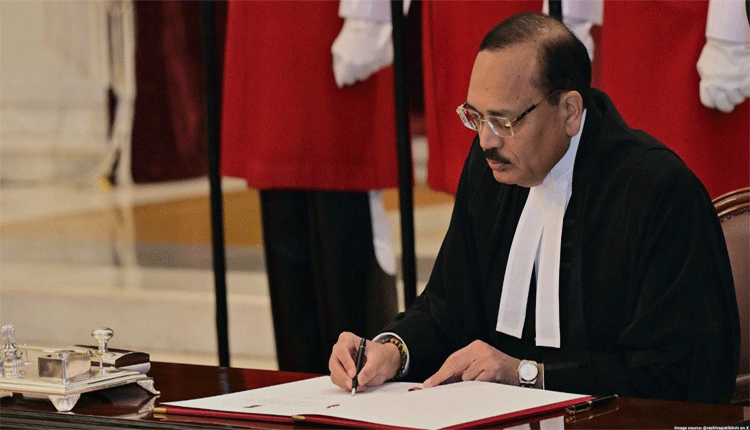
New Delhi: The Supreme Court on Wednesday came down heavily on the Gautam Buddha Nagar administration for issuing a preventive notice to a 20-year-old law student over his alleged participation in recent protests. The top court expressed immense outrage, questioning how an executive magistrate could issue such an order when explicit judicial directives protecting students from coercive action were already in place.

The controversy erupted after the district administration issued a notice to Akshat Tripathi, a student of Gautam Buddha University, on September 4. The student was accused of spreading anti-government propaganda and inciting his peers to join a protest at Jantar Mantar in Delhi.
When Senior Advocate Biswajit Bhattacharya drew the bench’s attention to the development, Chief Justice Surya Kant expressed his strong displeasure. The court stated it would seek a formal explanation from both the Gautam Buddha Nagar district administration and the concerned executive magistrate.
“How dare a magistrate issue a notice?” Chief Justice Surya Kant remarked sharply. “We had made it clear that no coercive action would be taken against any student! No magistrate can violate that order.”
The Chief Justice concurred with Bhattacharya’s submission that the mere issuance of the notice—even if it was reportedly withdrawn the following day—was a prima facie violation of the Supreme Court’s September 1 directive.
“Given our clear order, the question of taking action against a youngster does not arise at all. No one dares to violate our orders,” the CJI asserted.
The Supreme Court was referring to its comprehensive September 1 ruling, in which it invoked its extraordinary powers under Article 142 of the Constitution to quash criminal cases registered against students during the July protests led by the Cockroach Janta Party (CJP).
That specific bench, which also comprised Justices Joymalya Bagchi and K.V. Mohana, had ordered that no further action or investigation should proceed regarding FIRs registered between July 20 and 25 across various states and union territories. The court had categorically noted that merely participating in a protest cannot be deemed a crime under prevailing penal laws.
The landmark September 1 order had followed applications by the Centre, the Delhi Police, and the state governments of Maharashtra, Assam, Bihar, and West Bengal, seeking to close the criminal cases stemming from the agitations.
Comments are closed.