

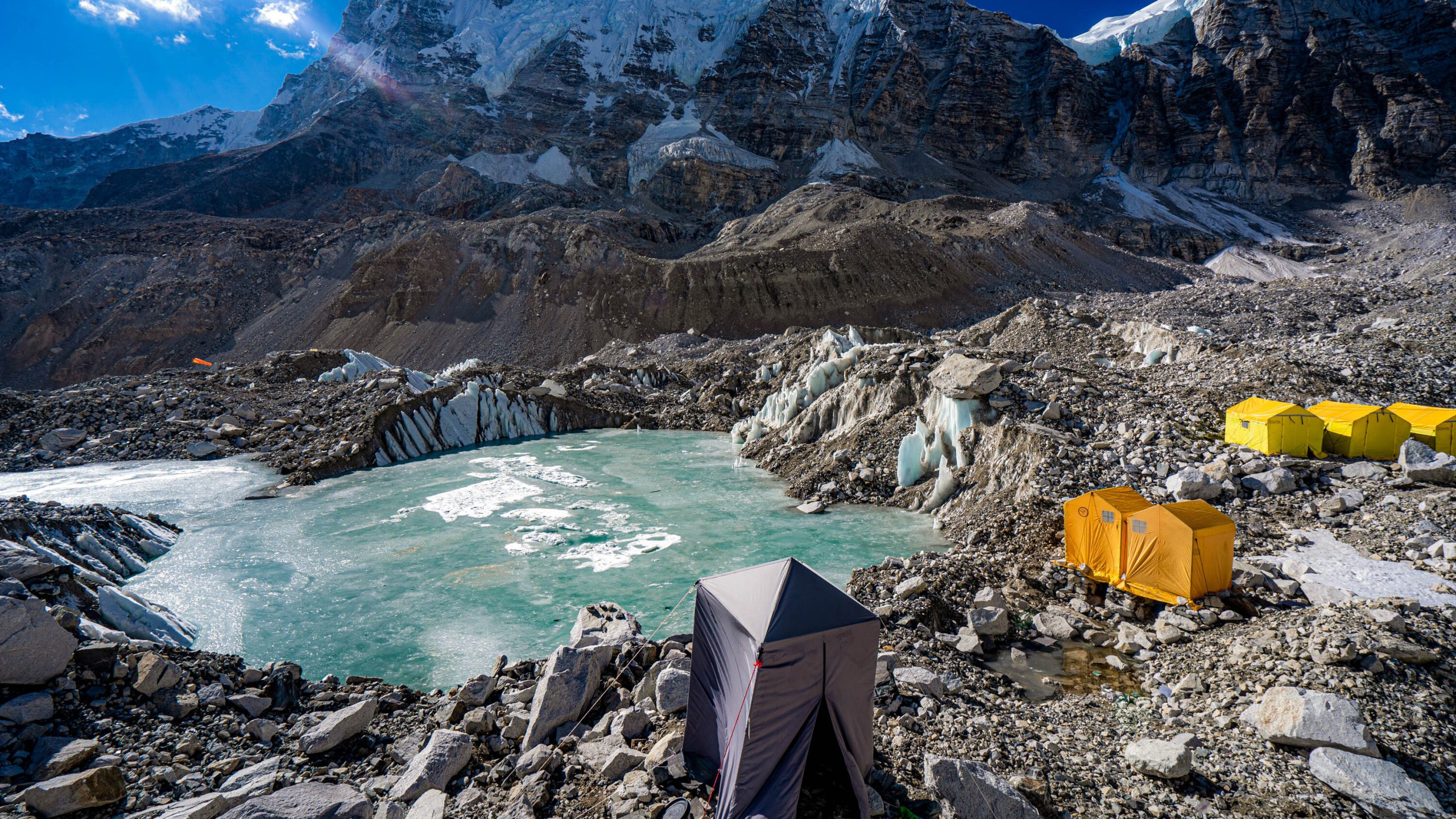
New Delhi: As global climate change continues to accelerate the shrinking of Himalayan glaciers, a new study has brought to light an unusual and concerning localized contributor: human urine and fossil fuel consumption by mountaineers.

According to a research paper published in the journal Regional Environmental Change by a team of scientists from Nepal and the United States, human activities at the Mount Everest Base Camp on the Khumbu Glacier are significantly speeding up the local melting of ice. The study revealed that the sheer volume of human urine, combined with massive fuel consumption, generates enough heat to melt thousands of tonnes of glacial ice during a single climbing season.
During the 50-day spring climbing expedition in 2023, the base camp hosted approximately 1,600 tents. Modern base camps have evolved beyond basic setups; many are now equipped with kitchens, hot showers, heated floors, and Wi-Fi, all of which require substantial energy. The research found that base camp operations in 2023 consumed 824 LPG cylinders, 18,935 litres of kerosene, and 5,130 litres of gasoline.
However, the most surprising finding was the environmental impact of bodily waste. To prevent severe dehydration at high altitudes, climbers and guides consume large quantities of water, resulting in the production of an estimated 6,766 litres of urine every single day. While solid human waste is typically collected and transported off the mountain, much of the urine is discharged directly onto the glacier. Leaving the human body at around 37 degrees Celsius, this biological waste acts as a direct, concentrated heat source.
The study estimates that human urine alone possessed enough thermal energy to melt nearly 154 tonnes of ice during the 2023 climbing season. While this sounds alarming, the researchers clarified that urine accounted for only about 6 per cent of the total human-induced ice melt at the camp. The vast majority—approximately 94 per cent—was driven by the combustion of fossil fuels for heating, cooking, and electricity. Combined, these activities generated roughly 849,174 megajoules of energy, which is theoretically capable of melting nearly 2,500 tonnes of ice and snow.
The report also highlighted that the surface temperature at the base camp has risen by an average of 0.28 degrees Celsius annually since 1991, which is almost double the warming rate of the adjacent areas of the Khumbu Glacier.
While emphasizing that global warming remains the primary culprit behind receding glaciers, scientists have urged authorities to adopt better expedition management. Experts are now advocating for a swift transition to solar energy, drastic reductions in fossil fuel usage, and are even exploring the possibility of relocating the base camp to stable, non-glacial ground to protect the fragile Himalayan ecosystem.
Comments are closed.