

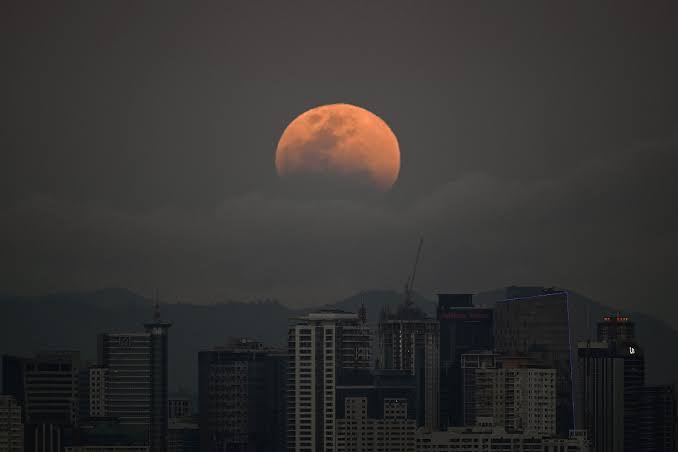
Washington: Skywatchers across large swathes of the globe are in for a spectacular celestial treat this Thursday night, as a deep partial lunar eclipse will grace the skies on August 27. Widely anticipated as one of the most significant astronomical events of the year, the eclipse will vividly transform the lunar surface, giving it a striking copper-red hue colloquially known as a “Blood Moon.”

According to local US time, the partial eclipse is scheduled to begin at 10:34 PM. The astronomical phenomenon will reach its peak at exactly 11:13 PM, when an impressive 96 per cent of the Moon will be swallowed by the Earth’s darkest central shadow, known as the umbra. During this peak phase, direct sunlight illuminating the lunar surface will be almost entirely blocked.
A report by the Washington Post confirms that this breathtaking event will be clearly visible across most parts of the United States—with the exception of Alaska and northwestern Canada—as well as throughout Western Europe and Western Africa.
The Science Of The Blood Moon
While it is technically a partial eclipse, the deep shadowing will create a highly dramatic visual effect. The US space agency NASA explains that the reddish appearance is caused by the exact same scientific mechanism that makes our sky blue during the day and sunsets red in the evening—a phenomenon known as Rayleigh scattering.
As the Earth perfectly aligns between the Sun and the Moon, it cuts off direct sunlight. However, some sunlight still passes through the edges of the Earth’s atmosphere. The atmosphere scatters away the shorter, blue wavelengths of light, allowing only the longer red and orange wavelengths to travel through and project directly onto the lunar surface. Essentially, the Moon reflects the combined glow of all the sunrises and sunsets happening on Earth at that exact moment.
Explore the stages of how the Earth’s shadow falls on the Moon below:
A Rare 18-Year Cycle
NASA notes that this particular lunar eclipse is part of a specific astronomical cycle that repeats itself exactly every 18 years, 11 days, and 8 hours. The previous eclipse in this specific cycle occurred on August 16, 2008, and the next one is not expected until September 7, 2044.
While total solar eclipses are notoriously rare and restricted to narrow viewing paths, lunar eclipses are much more democratic. According to astronomers, a lunar eclipse can be easily observed by anyone situated on the nightward side of the Earth, meaning skywatchers can generally witness such an event from their location approximately once every two and a half years.
Comments are closed.