

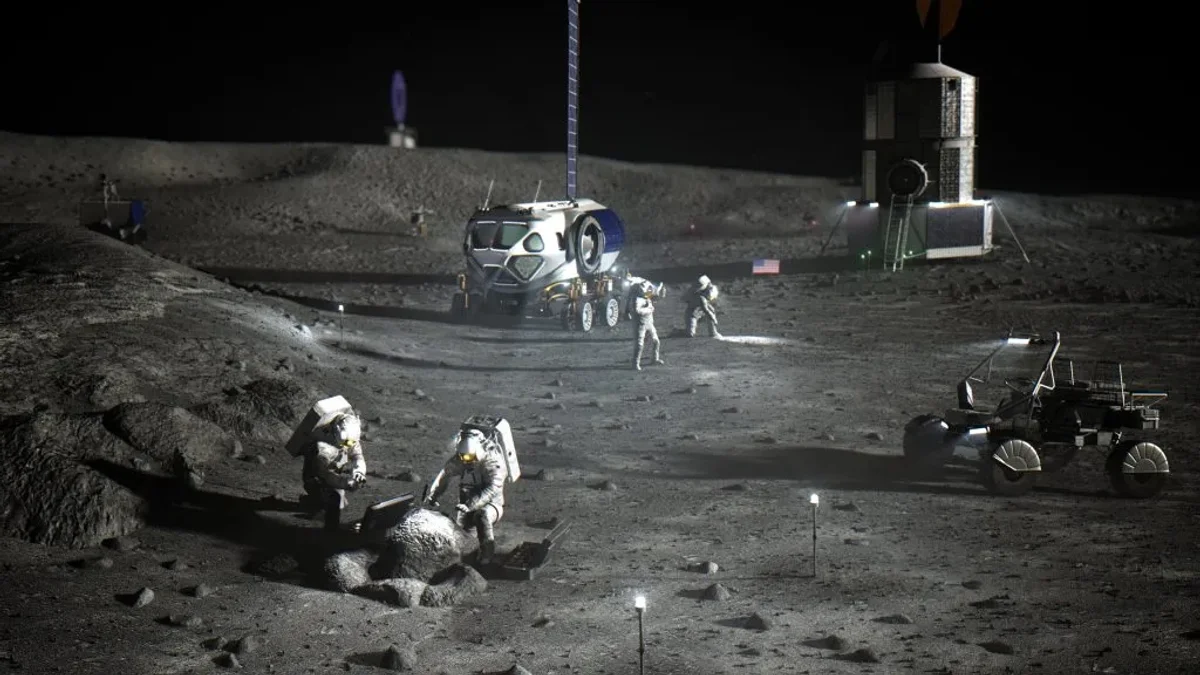
Washington: When humans step foot into the uncharted territories of the cosmos, they carry more than just scientific instruments and national flags. A new study by NASA has revealed a startling possibility: microscopic life from Earth could survive in the freezing, hostile environment of the Moon’s South Pole.

According to the research, published recently in the journal Science Advances, certain terrestrial microbes that naturally exist on the human body can endure the extreme cold and dark conditions of the lunar surface for at least a day. Scientists warn that completely preventing astronauts from carrying these microbes—such as various fungi and bacteria—to the Moon is nearly impossible. These microorganisms could potentially escape from spacesuits or habitats and settle directly on the lunar surface.
Prabal Saxena, a planetary scientist at NASA’s Goddard Space Flight Center who led the research, pointed out that human exploration inevitably brings along terrestrial biology. When humans venture into space for exploration, they carry their microbes along with their memories, the findings noted.
This revelation has sparked significant concerns within the scientific community regarding planetary protection. The primary fear is that the presence of Earth microbes could contaminate the Moon, making it incredibly difficult to accurately identify its original chemical and biological signatures. This complication poses an even greater threat to future manned missions to the Red Planet.
“We need to understand what was there before we arrived,” emphasized NASA scientist Andrew Needham. “When we go to Mars looking for life beyond Earth, we will want to be sure that what we find is not something we brought with us.”
To conduct the study, researchers simulated the extreme environmental conditions of three specific lunar South Pole locations: the Nobile Rim, Connecting Ridge, and de Gerlache Rim. Utilizing elevation, temperature, and radiation data sourced from NASA’s Lunar Reconnaissance Orbiter, the team tested several microbes commonly associated with human spaceflight. These included Aspergillus niger, Bacillus subtilis, Staphylococcus aureus, Deinococcus radiodurans, and various Fusarium species.
Despite the surprising resilience of these microorganisms, researchers clarified that merely surviving the harsh lunar environment does not mean the microbes will thrive or multiply. The Moon lacks the fundamental necessities required for microbial reproduction, most notably liquid water and conducive temperatures.
Therefore, while these microscopic stowaways can survive temporarily under severe stress, the likelihood of an active, spreading microbial colony on the Moon remains highly unlikely. Nonetheless, the findings serve as a crucial wake-up call for global space agencies to rigorously re-evaluate contamination protocols before the next generation of astronauts embarks on deep space exploration.
Comments are closed.