

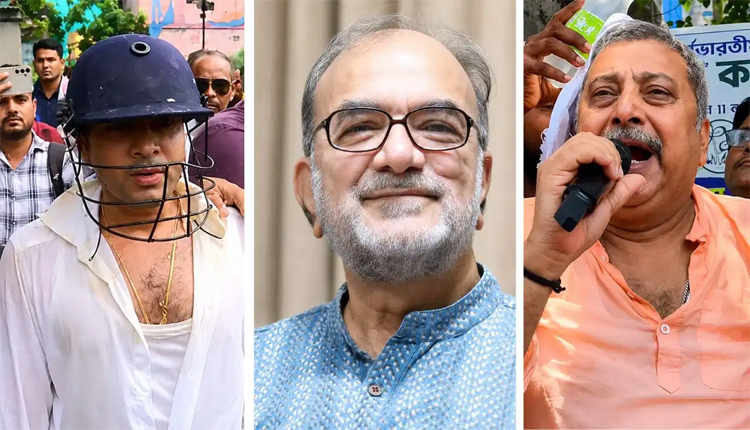
Kolkata: Senior CPI(M) leader and lawyer Bikash Ranjan Bhattacharya has sparked a fresh political debate in West Bengal after his remarks on whether he would legally represent Trinamool Congress leaders such as Abhishek Banerjee and Kalyan Banerjee if they approached him in court.

The controversy erupted after Bhattacharya appeared as legal counsel for former TMC MLA Aditi Munshi and her husband Debraj Chakraborty, who are facing allegations related to property disclosures and assets mentioned in election affidavits. His decision drew criticism from sections of the Left camp as well as political rivals, who questioned how a prominent anti corruption voice could defend leaders facing serious allegations.
Responding to the criticism, Bhattacharya defended his stand by stressing the distinction between politics and professional responsibility. The veteran lawyer said legal representation should not be viewed through a purely political lens and maintained that every individual is entitled to legal defence. He stated that as long as there was no ideological conflict with his professional principles, he would perform his duty as an advocate.
During the discussion, Bhattacharya was asked whether he would appear for senior TMC leaders including Abhishek Banerjee and Kalyan Banerjee. While reiterating his professional approach, he also alleged that several TMC leaders had been linked to corruption controversies. According to him, legal representation and political opposition are separate matters and should not be mixed.
The remarks triggered reactions from the Trinamool Congress. TMC MP and lawyer Kalyan Banerjee indirectly criticised Bhattacharya through a social media post, accusing an unnamed senior advocate of adopting contradictory positions on corruption. Banerjee questioned how someone who had strongly argued corruption cases in court could simultaneously defend leaders accused in similar matters. He further suggested that such actions naturally raise political questions regarding the relationship between opposition parties in the state.
The issue has also exposed divisions within sections of the Left ecosystem. Some CPI(M) supporters and leaders publicly expressed discomfort over Bhattacharya representing former TMC figures. Social media discussions among party supporters questioned whether professional obligations should outweigh political ideology in sensitive cases involving corruption allegations.
Bhattacharya, however, rejected the criticism and argued that legal ethics require advocates to represent clients irrespective of political affiliations. Drawing an analogy, he said a doctor does not refuse treatment based on a patient’s political beliefs, and lawyers too must uphold professional commitments.
The controversy comes at a time of heightened political confrontation in West Bengal, where the BJP, TMC and Left parties continue to exchange allegations over corruption, governance and post election violence. Political observers believe the debate has once again highlighted the complex intersection of law, ethics and politics in the state’s charged political environment.
Comments are closed.