

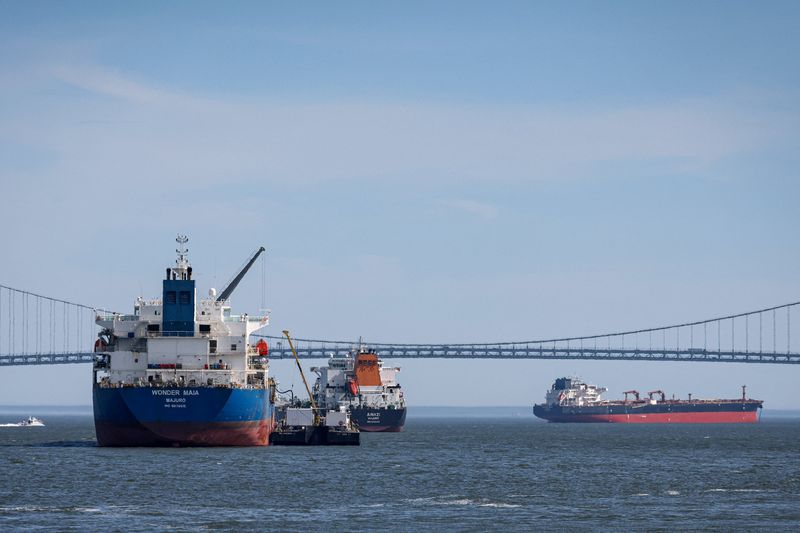
Houston: In a historic reversal of a century-long trend, the United States is on the precipice of becoming a net exporter of crude oil for the first time since the Second World War.

The ongoing conflict with Iran, which has choked the world’s most vital energy arteries, has triggered a radical realignment of the global oil trade, turning America into the primary “filling station” for Europe and Asia.
According to the latest government data released this week, US net crude imports — the narrow margin between what the country buys and what it sells — shrank to just 66,000 barrels per day. With exports surging to 5.2 million barrels per day, analysts suggest that by May, the US will officially transition into a net exporter, a status it has not held on an annual basis since 1943.
The Hormuz Chokehold
The catalyst for this shift is the “largest ever disruption to the global energy market.” With roughly 20 per cent of the world’s seaborne oil and gas flows halted by the blockade of the Strait of Hormuz, refineries in Europe and Asia have been left scrambling for alternatives.
Refiners who once looked to the Persian Gulf are now turning to the Permian Basin. Ship-tracking data reveals that nearly half of all US crude exports — some 2.4 million barrels per day— are now sailing for Europe, while Asian shipments have jumped to 37 per cent of the total. Even traditional buyers of Middle Eastern crude, such as Greece and Turkey, have snapped up American light sweet crude for the first time in recent memory.
A ‘War Premium’ For Brent
The economic incentive for this shift is stark. The disruption has blown out the “Brent-WTI spread”— the price difference between international and American benchmarks— to over $20 per barrel. With physical crude prices for prompt delivery in Europe hitting a record $150 a barrel this week, US oil has become an irresistible alternative for foreign buyers, despite the logistical hurdles. However, the “Shale Revolution” is now testing its own limits.
Experts at Rystad and Kpler warn that the US is rapidly approaching its “export ceiling.” With an absolute capacity limit of roughly 6 million barrels per day, constrained by pipeline infrastructure and a shortage of empty supertankers, every incremental barrel is becoming increasingly expensive to transport.
The Geopolitical Pivot
The transition from a net importer to a net exporter is more than a statistical milestone; it is a profound geopolitical pivot. For decades, US foreign policy was dictated by the need to secure foreign oil; in 2026, the US finds itself wielding energy as a weapon of stability for its allies. Yet, this shift comes with a domestic sting.
While the US exports record volumes, domestic refineries, largely designed to process the heavier grades of crude found in the Middle East, are struggling to adapt to the light, sweet crude produced at home. For the average American at the petrol pump, the status of “net exporter” has done little to shield them from the global price surge, proving that in a globalised economy, independence is a relative term.
Comments are closed.