

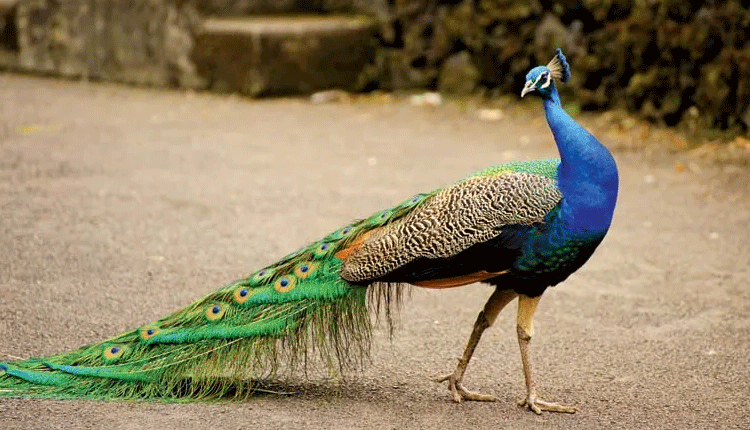
New Delhi: The magnificent peacock (Pavo cristatus) was officially declared the national bird of India on February 1, 1963. However, this prestigious title was not handed to the beautiful bird without competition. According to government documents and wildlife archives, several other birds, including the highly endangered Great Indian Bustard and the Sarus Crane, were strong contenders for the title before the final stamp of approval was given to the peacock.

The idea to designate a national bird originated during the International Council for Bird Preservation conference held in Tokyo in May 1960. Following this, the Indian Board for Wildlife, then chaired by the former Maharaja of Mysore, Jayachamarajendra Wadiyar, was tasked with the selection process. While renowned ornithologist Salim Ali advocated for the Great Indian Bustard to draw attention to its conservation, the peacock ultimately won due to five distinct factors.
First, widespread presence was a crucial criterion. The Indian Board for Wildlife emphasised that a national symbol should not be limited to a specific region. Unlike the Great Indian Bustard, the peacock is found across almost every Indian state, thriving in fields, villages, and forests.
Second, the bird needed to be easily identifiable by the common citizen. With its vibrant blue neck, striking crest, and spectacular iridescent tail feathers, the peacock’s appearance is unmistakable.
Third, deep mythological and religious significance played a vital role. In Hindu traditions, the peacock is revered as the mount of Lord Kartikeya (Murugan), while peacock feathers are inseparably linked to the crown of Lord Krishna.
Fourth, the bird has maintained a continuous presence in Indian art, architecture, and history for centuries. Its motifs have adorned ancient temple carvings, royal emblems, coins, and traditional textiles, making it a shared symbol of the nation’s cultural heritage.
Lastly, as highlighted by the government’s Knowledge India portal, the peacock perfectly embodies the nation’s values of beauty, dignity, and pride. Its famous rain-dance remains an integral part of Indian folklore.
Following its official designation, the peacock received the highest legal protection. It was placed under Schedule I of the Wildlife Protection Act of 1972, affording it the exact same conservation status and stringent anti-poaching laws as the Bengal Tiger. Furthermore, the export of peacock tail feathers and derivative products remains strictly prohibited.