

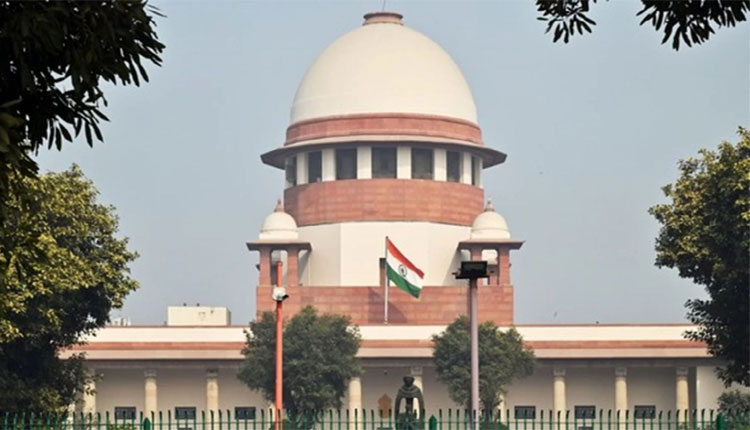
New Delhi: Emphasizing that a marriage cannot be forced upon a couple whose bond has irretrievably broken down, the Supreme Court has granted a divorce to an estranged couple who have been living separately since December 2005.

The apex court bench, comprising Justice Prashant Kumar Mishra and Justice Chandrashekhar, approved the dissolution of the marriage, directing the husband to pay a permanent alimony of Rs 7 lakh to the wife. The ruling overturned a previous judgment by the Madhya Pradesh High Court, which had refused to grant the divorce decree on the grounds that the husband had failed to explicitly prove cruelty and desertion.
The case traces back to June 2003, when the couple tied the knot. According to court records, the marital discord began shortly after the wedding, primarily stemming from the wife’s dissatisfaction with her husband’s educational qualifications. The husband alleged that his wife frequently humiliated him, allegedly calling him “illiterate and uncultured” (anpadh-ganwar). The situation deteriorated further, and the wife ultimately left for her maternal home in November 2005.
In June 2007, the husband filed a divorce petition under Section 13 of the Hindu Marriage Act, 1955, citing mental cruelty and desertion. While the Madhya Pradesh High Court had previously dismissed his plea, the Supreme Court took a more pragmatic view of the prolonged separation.
During the proceedings, the top court noted that the husband had made attempts to bring his wife back to her matrimonial home, but she refused to accompany him without any concrete reason. The bench also observed that the marriage had produced no children and that all attempts at reconciliation had failed miserably over the years.
“Although the primary purpose of matrimonial law is to preserve marriage, when parties live apart for a long period, the law must acknowledge the reality of such a situation,” the bench observed. The court emphasized that a prolonged period of separation is a crucial factor in determining whether a marital tie can be repaired.
While the wife claimed in her statement that she was willing to fulfill her marital obligations, the Supreme Court noted that mere words were insufficient when her actual conduct indicated otherwise. Concluding the judgment, the bench stated that forcing the parties to remain in a dead marriage would not serve the purpose of justice, officially bringing the 21-year-old legal and marital battle to a close.
Comments are closed.