

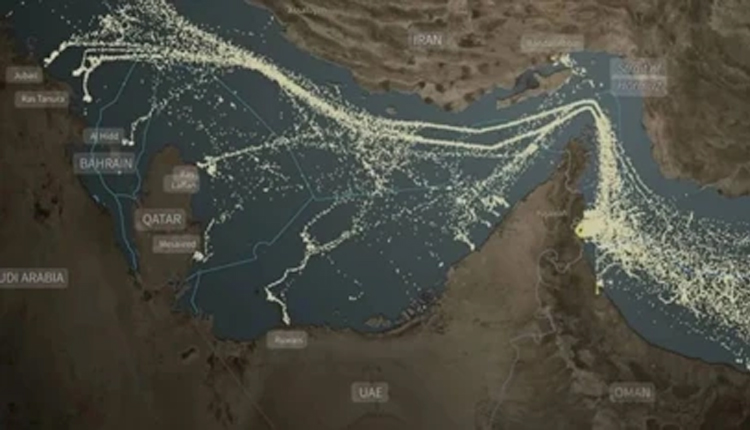
Oman: Amid rising geopolitical tensions in the Middle East, the Strait of Hormuz has once again emerged as a flashpoint, with Iran imposing a shipping ban that threatens global energy supplies.
This narrow maritime passage, crucial for oil transit, has sparked fears of shortages, particularly impacting nations like India, which relies on it for nearly 2.6 million barrels of crude oil daily.
The strait serves as a vital link between the Persian Gulf and the Gulf of Oman, extending into the Arabian Sea. Bordered by Iran to the north and the Musandam Peninsula of Oman alongside the United Arab Emirates to the south, it sits at the epicentre of the world’s energy hub. Despite its strategic weight, the waterway narrows to just 33 kilometres at its tightest point, with shipping channels for massive oil tankers restricted to a mere three kilometres in each direction. This confined corridor handles thousands of vessels laden with crude oil and liquefied natural gas, making any disruption a potential economic catastrophe.
Often dubbed the planet’s most critical energy chokepoint, the Strait of Hormuz facilitates 20 to 30 per cent of global oil trade. Key exporters, including Saudi Arabia, Iran, the UAE, Kuwait, and Iraq, depend on it to supply markets in Asia, Europe, and beyond. Iran’s Islamic Revolutionary Guard Corps has clarified that the ban targets vessels from the United States, Israel, Europe, and their Western allies, escalating the standoff.
The strait’s name traces back to rich historical roots. One theory ties it to the Middle Persian term ‘Hormoz’, inspired by Ahura Mazda, the supreme deity in ancient Zoroastrianism, symbolising a sacred pathway for Persians. Historically, from the 11th to 17th centuries, the Hormuz Empire — centred on an island trade hub connecting Persia, Arabia, India, and East Africa — lent its name to the gulf. Some scholars also link it to the local Persian phrase ‘Hur Mogh’, denoting the abundant date palms in the region.
As tensions simmer, the world watches closely, underscoring the strait’s enduring role in global stability.
Comments are closed.