

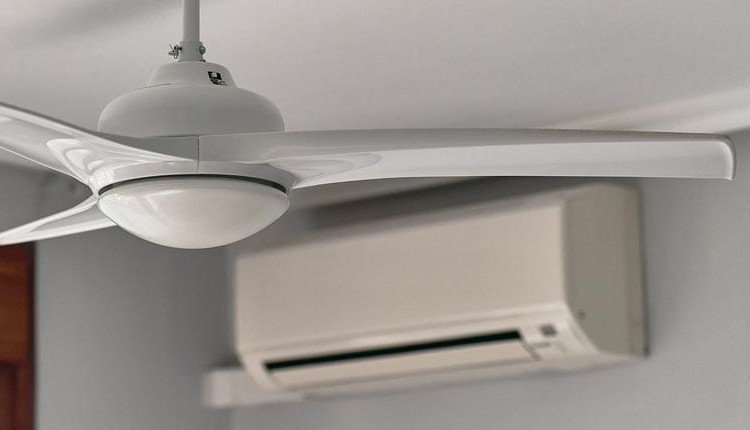
As scorching summer heat grips India, many households grapple with soaring electricity bills from air conditioners.
A common debate persists: does running a ceiling fan alongside an AC waste power or actually help save it while enhancing comfort?
Experts and practical advice lean towards a resounding yes — using a fan with your AC is not only advisable but can significantly improve cooling efficiency and cut electricity costs, provided it’s done the right way.
The key lies in air circulation. Cool air from the AC tends to settle near the floor and vents, leaving upper parts of the room warmer. A ceiling fan at medium or normal speed swiftly distributes this chilled air evenly across the room, reaching corners faster and creating uniform cooling. This allows users to set the AC thermostat higher — typically 24-26°C instead of the usual 18-22°C— without sacrificing comfort, thereby reducing the compressor’s workload and power draw.
Since a ceiling fan consumes far less electricity (often under 75 watts) compared to an AC (1,000–2,000 watts or more), the minor additional usage is more than offset by the savings from running the AC less intensely. Many specialists recommend this combination for faster cooling, better temperature balance, and lower bills.
However, moderation is crucial. Avoid high fan speeds, which can disrupt the cool air flow or create unnecessary noise. In tiny rooms where AC airflow already covers the space adequately, a fan may not be essential. Always keep doors and windows closed to trap the cool air.
This straightforward adjustment — setting the fan to medium and the AC to 24-25°C— provides a cost-effective, energy-efficient method to combat the heat.
Comments are closed.